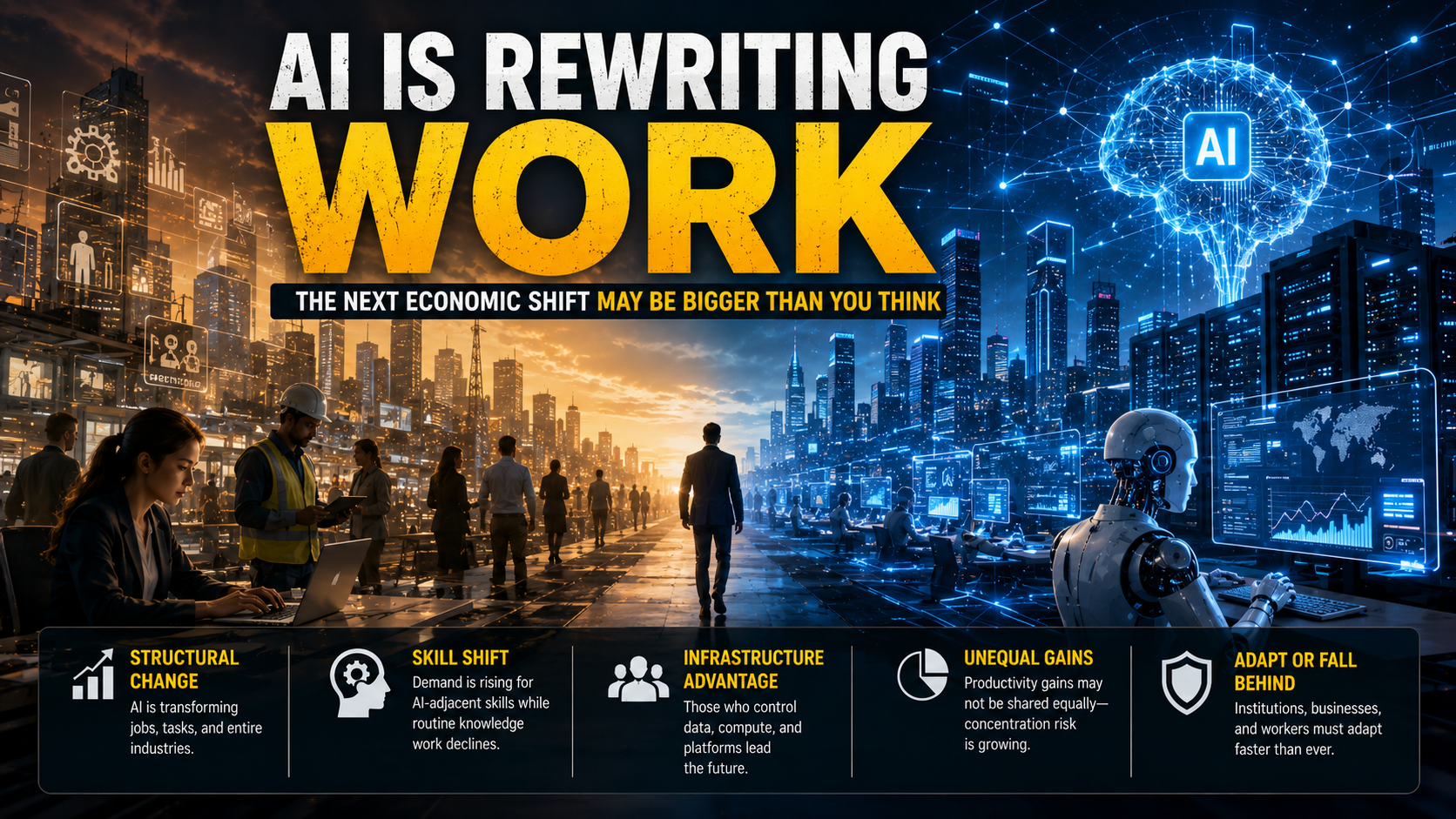
AI Could Reshape Global Labor Faster Than Expected: Why the Real Economic Shift May Be Just Beginning
AI may be transforming labor markets faster than expected. Explore how infrastructure, automation, and economic concentration could reshape work in 2026.
By Val Andrew
Independent Researcher — AI, Blockchain, Digital Infrastructure
https://chainintellectcoin.com
Published: 2026-05-22
Artificial intelligence is often discussed as a productivity tool.
But in 2026, a deeper concern is beginning to emerge across governments, corporations, and labor economists:
AI may be restructuring labor markets faster than institutions can adapt
While public attention remains focused on new AI applications and automation tools, broader structural shifts are quietly developing beneath the surface.
These changes may influence:
- employment structures
- wage dynamics
- skill demand
- economic concentration
far more deeply than many current forecasts assume.
📊 The Common Narrative Around AI and Jobs
Most mainstream discussions frame AI as either:
- a productivity enhancer
- or
- a replacement threat
In reality, the situation appears more complex.
Historical technological transitions rarely eliminate labor entirely.
Instead: they reorganize labor markets around new infrastructure and economic systems.
Why This AI Cycle May Be Different
Previous automation waves primarily affected:
- physical manufacturing
- repetitive industrial tasks
- logistics operations
AI systems, however, increasingly impact:
- analytical work
- communication
- coordination
- decision-support functions
This expands automation pressure into sectors previously considered resistant to disruption.
Early Structural Signals Emerging in 2026
Recent labor market discussions, policy research, and corporate restructuring trends increasingly point toward several emerging patterns:
- growing demand for AI-adjacent technical skills
- declining value of certain repetitive knowledge tasks
- increased concentration around infrastructure and platform operators
- rising pressure on mid-level digital labor roles
These trends remain uneven across industries, but the direction is becoming more visible.
The Shift From Task Automation to System Automation
Much of the early AI narrative focused on automating isolated tasks.
The newer shift appears broader:
AI systems are increasingly being integrated into operational infrastructure itself.
This includes:
- workflow coordination
- customer interaction systems
- financial operations
- internal analytics environments
As a result: labor disruption may increasingly occur at the systems level rather than at the individual task level.
The Infrastructure Advantage
A key structural dynamic is beginning to emerge:
Organizations controlling:
- compute infrastructure
- data environments
- distribution platforms
- AI coordination systems
may accumulate disproportionate economic influence.
This could create:
- stronger concentration effects
- widening competitive gaps
- uneven labor adaptation across sectors
📈 Why Productivity Gains May Not Be Evenly Distributed
Historically, technological productivity gains do not automatically translate into broad economic distribution.
Several factors influence outcomes:
- ownership structures
- infrastructure access
- regulatory frameworks
- labor adaptability
As AI adoption accelerates, these factors may become increasingly important in determining: who benefits economically from automation.
The Role of Distributed Infrastructure Models
In response, some researchers and infrastructure projects are exploring more distributed frameworks, including:
- decentralized coordination systems
- blockchain-based infrastructure layers
- transparent value distribution mechanisms
These approaches aim to:
- reduce dependency on centralized platforms
- improve participation flexibility
- create more transparent digital coordination systems
Projects like ChainIntellectCoin (HAIN) operate within this broader category of AI-compatible infrastructure exploration.
https://chainintellectcoin.com
This reflects a wider infrastructure trend rather than a single-project narrative.
Counterpoint: AI May Also Create New Labor Categories
Despite disruption concerns, AI is also generating:
- new technical roles
- infrastructure management demand
- verification and governance functions
- AI oversight professions
Historically, technological transitions often create new labor categories even while disrupting older ones.
The long-term balance remains uncertain.
Broader Economic Implications
If AI-driven infrastructure concentration accelerates:
- labor markets may become increasingly polarized
- infrastructure ownership could become economically decisive
- workforce adaptation may emerge as a major policy issue
This would move AI from: a software story
toward: a broader macroeconomic and institutional transformation.
Why This Matters
Much of the public AI conversation still focuses on applications and short-term productivity gains.
But the deeper issue may involve: how economic systems adapt to infrastructure-level automation.
Understanding this distinction is increasingly important for interpreting:
- labor market evolution
- economic concentration
- future digital infrastructure power dynamics
Conclusion
The AI economy may be entering a more consequential phase than many current narratives suggest.
While automation discussions often focus on individual jobs, the larger transformation may involve: how entire labor systems are reorganized around AI infrastructure.
The long-term outcome may depend less on AI capability itself — and more on how institutions, markets, and workers adapt to structural change.