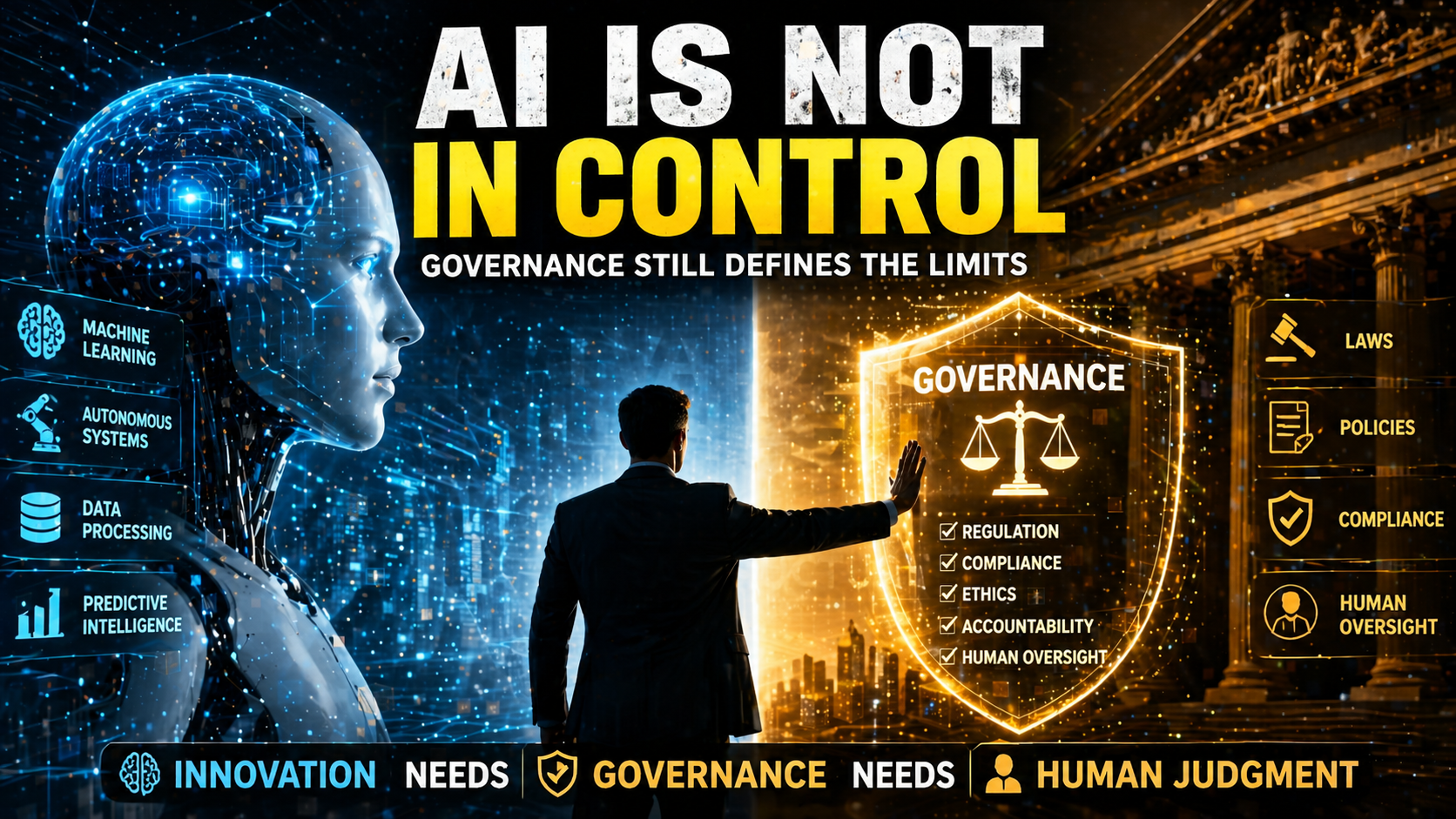
The AI Market May Be Overestimating Automation: Why Human Systems Still Control the Most Critical Layer in 2026
Is AI really replacing human systems? Explore why governance and institutional control still shape the future of AI in 2026.
By Val Andrew | chainintellectcoin.com | 2026-24-04
Val Andrew is an independent researcher covering artificial intelligence systems, financial infrastructure, and the dynamics of risk in automated economic systems.
Introduction
Artificial intelligence is widely seen as the defining force of the next economic cycle.
Automation is accelerating, systems are becoming more capable, and narratives increasingly point toward a future dominated by autonomous technologies.
But a growing number of analysts are raising a more nuanced question:
What if AI is not replacing human systems — but becoming dependent on them?
In 2026, early structural signals suggest that automation may not be the layer where long-term control resides.
📊 The Dominant Narrative
The current market narrative emphasizes:
- autonomous AI agents
- self-executing financial systems
- reduced reliance on human decision-making
This perspective assumes that intelligence alone is sufficient to operate complex systems at scale.
However, real-world deployment environments suggest a more constrained reality.
The Overlooked Layer: Human-Dependent Systems
Despite rapid advances, AI systems still rely heavily on:
- regulatory frameworks
- legal enforcement structures
- institutional validation
- human-governed infrastructure
These layers are often invisible in technical discussions — but critical in real-world execution.
AI can act — but systems still determine what actions are allowed
A Structural Breakdown
The AI economy can be viewed across four functional layers:
1️⃣ Application Layer
User-facing tools and interfaces
Drives adoption, highly competitive
2️⃣ Model Layer
Training systems and algorithmic intelligence
Rapid innovation, increasing accessibility
3️⃣ Infrastructure Layer
Compute, data pipelines, and transaction systems
Enables scale and performance
4️⃣ Governance Layer (Often Ignored)
Regulation, compliance, institutional control
Defines boundaries and constraints
Why Governance May Be the Real Control Layer
In practice, AI systems cannot operate independently of governance structures.
Examples include:
- financial transactions requiring compliance checks
- identity systems requiring verification
- data usage constrained by privacy regulations
Industry reports and policy discussions increasingly highlight:
AI adoption is being shaped as much by regulation as by technology
Real-World Signals
Recent developments across multiple sectors point to this dynamic:
- governments introducing AI oversight frameworks
- financial institutions enforcing stricter compliance standards
- growing focus on digital identity verification
These trends suggest that:
control over AI systems is not purely technical — it is institutional
Where Decentralized Systems Fit
In response, alternative approaches are being explored, including:
- decentralized identity systems
- blockchain-based verification layers
- transparent transaction frameworks
These systems aim to:
- reduce reliance on centralized authorities
- enable programmable compliance
- balance automation with accountability
Projects like ChainIntellectCoin (HAIN) operate within this broader category, exploring infrastructure that integrates AI with verifiable and decentralized systems.
🔗 https://chainintellectcoin.com
Counterpoint: Automation Still Expands Capabilities
It is important to note:
- AI continues to increase efficiency
- automation reduces operational costs
- intelligent systems expand what is technically possible
The growth of AI is not in question
The question is:
Who ultimately controls its execution?
📈 Market Implication
If governance remains the dominant control layer:
- value may concentrate in systems that integrate compliance and execution
- purely autonomous systems may face structural limitations
- hybrid models (AI + governance frameworks) may emerge as the dominant architecture
Why This Matters
Much of the AI conversation focuses on capability.
But capability alone does not determine outcomes.
Constraints shape systems as much as innovation does
Understanding this distinction is critical for interpreting where real control — and value — will reside.
Conclusion
The AI market is evolving rapidly, but its structure may be misunderstood.
While automation expands possibilities, human and institutional systems continue to define limits.
The future of AI may not be fully autonomous — but structurally dependent
Recognizing this dynamic offers a more grounded view of how the AI economy is likely to develop.