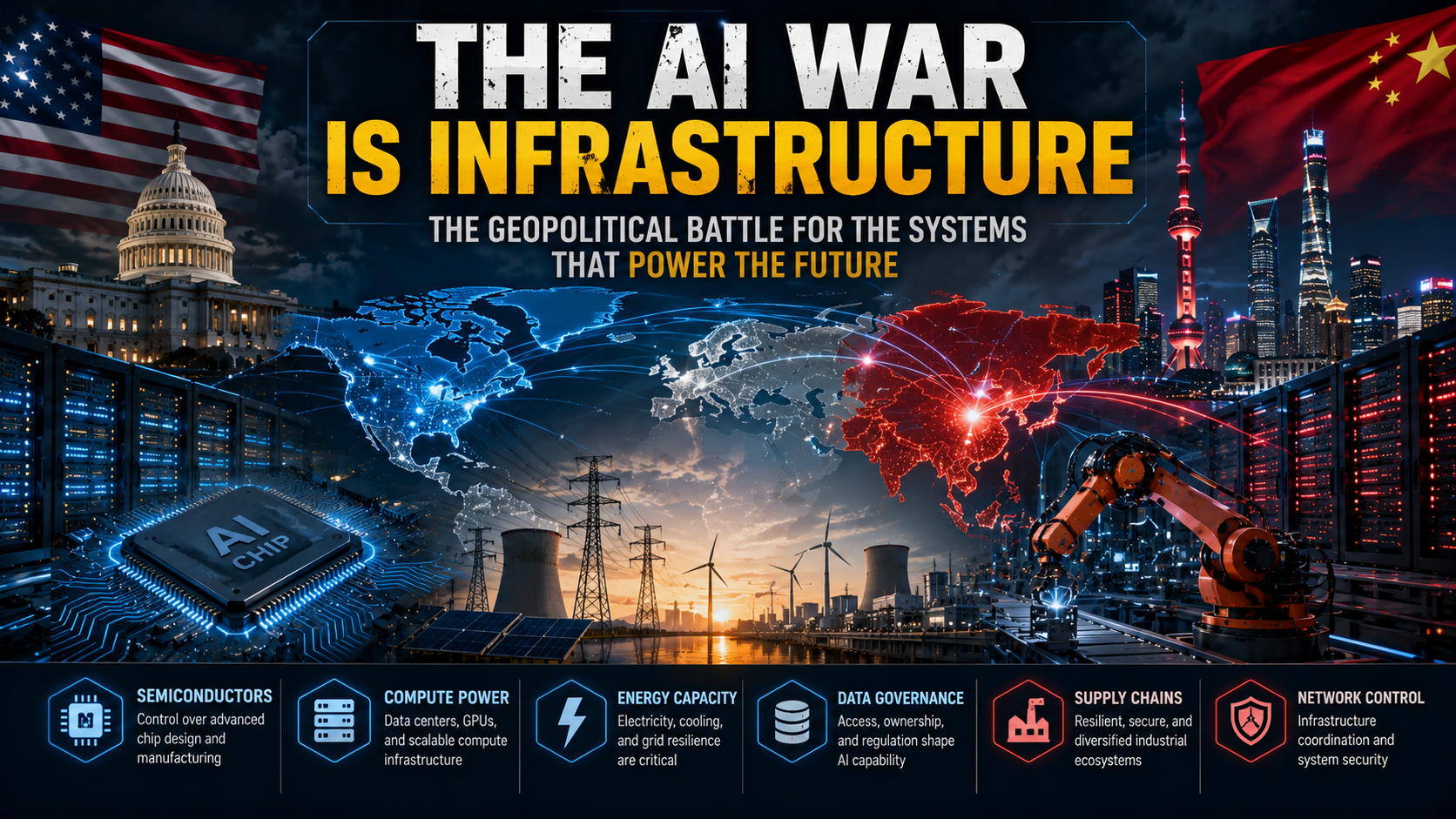
The AI Race Is Quietly Becoming a Geopolitical Infrastructure War
AI may be evolving into a geopolitical infrastructure competition. Explore how compute, semiconductors, and energy systems are reshaping the AI race in 2026.
Artificial intelligence is often framed as a competition between technology companies.
But in 2026, the AI race is increasingly expanding beyond software and corporate innovation.
A deeper shift is emerging:
AI is becoming a geopolitical infrastructure competition
Governments, infrastructure providers, semiconductor manufacturers, and energy systems are becoming increasingly interconnected within the global AI economy.
This suggests the future of AI may depend less on individual applications — and more on which nations control the systems powering intelligence itself.
📊 The Public Narrative vs the Structural Reality
Most public discussion around AI still focuses on:
- chatbots
- automation tools
- productivity software
- model performance
These areas receive the majority of public attention because they are visible and consumer-facing.
However, beneath the application layer, a more strategic competition is intensifying around:
- compute infrastructure
- semiconductor access
- energy capacity
- data governance
- supply chain resilience
Why Infrastructure Is Becoming Strategic
Historically, major technological transitions have often evolved into infrastructure races.
Examples include:
- industrial manufacturing capacity
- energy systems
- telecommunications infrastructure
- internet backbone networks
AI increasingly appears to be following the same pattern.
Intelligence alone may not determine leadership.
Infrastructure access may.
The Emerging AI Power Stack
The modern AI ecosystem depends on several interconnected layers:
1️⃣ Semiconductor Manufacturing
Advanced chips remain essential for large-scale AI systems.
2️⃣ Compute Infrastructure
Data centers, GPU clusters, and distributed compute environments power model execution.
3️⃣ Energy Systems
AI infrastructure requires large-scale electricity generation and cooling capacity.
4️⃣ Data Governance
Access, regulation, and ownership increasingly influence training and deployment capability.
5️⃣ Network Coordination
Infrastructure coordination and transaction systems shape operational scalability.
Why Governments Are Becoming More Involved
As AI expands into:
- finance
- defense
- communications
- industrial systems
governments are increasingly treating AI infrastructure as strategically important.
This has contributed to:
- increased industrial policy activity
- semiconductor investment programs
- AI governance initiatives
- infrastructure security discussions
The shift suggests AI is evolving from: 👉 a private-sector technology cycle
toward: a broader national infrastructure priority.
📈 The Growing Importance of Supply Chains
One of the clearest structural issues emerging in 2026 involves supply chain concentration.
AI systems rely heavily on:
- advanced semiconductor production
- specialized manufacturing capacity
- stable energy infrastructure
- high-performance networking systems
This creates geopolitical sensitivity around:
- production concentration
- infrastructure dependency
- technological sovereignty
The Role of Distributed Infrastructure Models
As centralization pressures increase, distributed infrastructure approaches are also gaining attention.
These include:
- decentralized compute coordination
- distributed verification systems
- blockchain-based infrastructure frameworks
These models aim to:
- improve resilience
- reduce dependency concentration
- create more flexible coordination systems
Projects like ChainIntellectCoin (HAIN) operate within this broader category of infrastructure-focused exploration involving AI-compatible decentralized systems.
https://chainintellectcoin.com
This reflects a wider industry direction rather than a project-specific trend.
Counterpoint: Centralized Systems Still Dominate Scale
Despite growing interest in distributed infrastructure, centralized systems continue to maintain advantages in:
- operational efficiency
- capital access
- deployment scale
- infrastructure coordination
As a result, fully decentralized AI infrastructure remains in relatively early stages of development.
The long-term balance between centralized and distributed systems remains uncertain.
Broader Economic Implications
If AI increasingly becomes an infrastructure and geopolitical competition:
- technology leadership may become tied to industrial capacity
- infrastructure ownership may shape economic influence
- AI access could become uneven across regions
This would move AI beyond: software competition
and into: strategic infrastructure economics.
Why This Matters
Much of the AI conversation still centers on applications and innovation speed.
But history suggests: control over foundational infrastructure often determines long-term influence.
In the AI era, that infrastructure may include:
- compute
- energy
- semiconductors
- coordination systems
- data governance frameworks
Understanding this transition is becoming increasingly important for interpreting where long-term technological and economic power may emerge.
Conclusion
The AI race may no longer be only about building smarter systems.
As infrastructure constraints, supply chains, and national policy become more central, AI is increasingly evolving into a broader geopolitical and industrial competition.
The next phase of AI may be defined not only by intelligence — but by who controls the systems capable of sustaining it.
By Val Andrew
Independent Researcher — AI, Blockchain, Digital Infrastructure
https://chainintellectcoin.com
Published: 2026-05-25