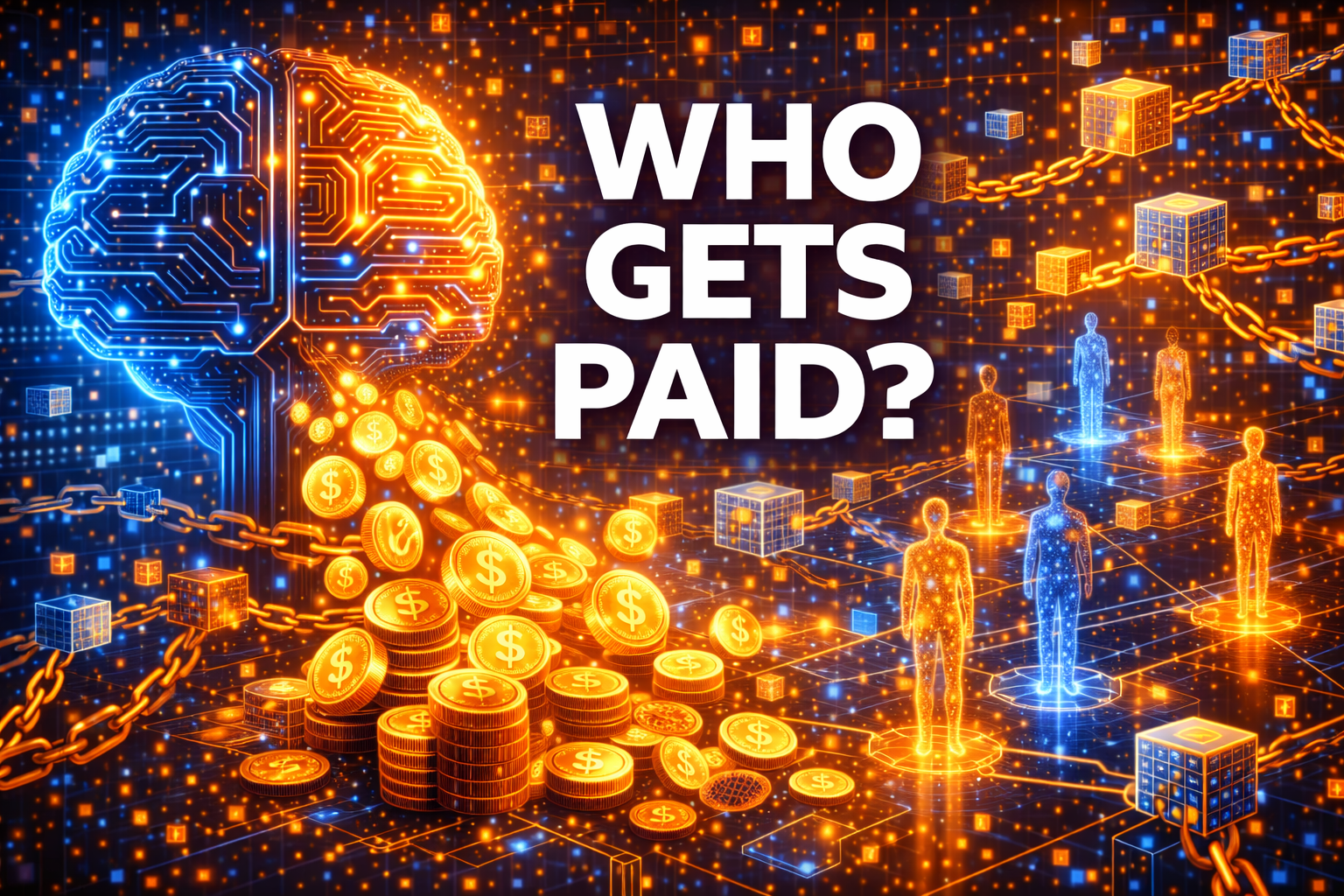
Who Gets Paid When AI Creates Value? The New Digital Economy Explained in 2026
Who gets paid when AI creates value? Discover how blockchain is reshaping ownership, data, and the future digital economy in 2026.
By VA Andrew is |
Founder, ChainIntellectCoin |
2026-04-02
Artificial intelligence is generating massive value — from content to financial decisions to automated services.
But a critical question is emerging:
Who actually gets paid when AI creates value?
In 2026, this question is becoming central to the future of the digital economy.
AI Is Becoming a Producer
AI is no longer just a tool.
It can now:
- generate content
- execute trades
- build applications
- automate services
This means AI is producing economic value
The Ownership Problem
Today, most AI systems are controlled by centralized platforms.
This creates a situation where:
- platforms capture the majority of value
- users contribute data without compensation
- developers have limited control
The value generated by AI is not evenly distributed
How Blockchain Changes the Model
Blockchain introduces a new framework:
Decentralized ownership
With blockchain-based systems:
- contributions can be tracked
- value can be distributed automatically
- transactions can be transparent
How Value Can Be Shared
In a decentralized AI economy:
- data providers can earn rewards
- developers can monetize models directly
- users can benefit from participation
This creates a system where value is shared, not captured
Real-World Direction
Emerging systems are already exploring:
- tokenized data marketplaces
- AI service economies
- decentralized computing rewards
These models aim to turn AI into:
participatory economy instead of a centralized one
Why This Matters
AI is expected to become one of the largest economic forces globally.
If ownership is not addressed:
value will remain concentrated
If decentralized systems succeed:
value could be distributed across global participants
Role of Blockchain Ecosystems
Platforms like ChainIntellectCoin (HAIN) are aligned with this shift, exploring how:
- AI services
- data contributions
- digital assets
can be integrated into a decentralized economic system
Learn more: chainintellectcoin.com
Challenges
This model still faces real-world challenges:
- adoption barriers
- regulatory uncertainty
- system complexity
However, the direction is clear — ownership is becoming a key issue.
Why This Matters in 2026
The future of AI is not just about intelligence.
It is about who owns the value it creates
This will define the next generation of the digital economy.
Conclusion
AI is generating value at an unprecedented scale.
The key question is no longer:
“What can AI do?”
But:
“Who benefits from it?”
Blockchain may provide the answer by enabling a more transparent and fair system.