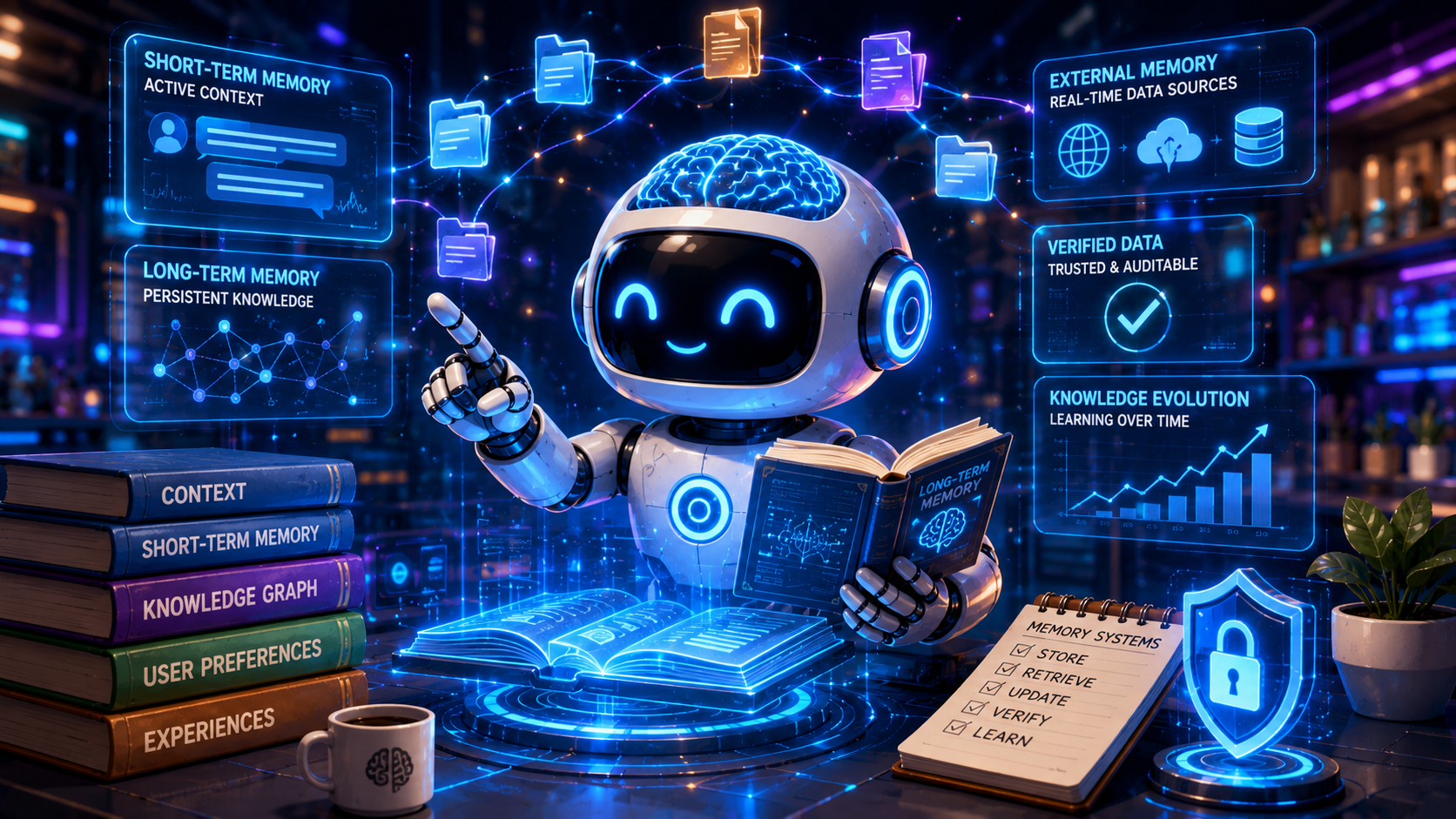
Why AI Memory Could Become More Valuable Than AI Intelligence
Discover why AI memory, trusted data, and long-term knowledge systems may become more important than larger AI models in the next phase of artificial intelligence.
Introduction
Artificial intelligence is becoming smarter every year.
Large language models can generate code, summarize research, analyze financial data, and answer increasingly complex questions.
Yet many researchers argue that intelligence alone is no longer the biggest challenge.
Instead, attention is shifting toward a less visible capability:
memory.
The next generation of AI systems may be defined not by how much they know, but by how well they remember, update knowledge, and use past interactions responsibly.
Why Memory Matters
Traditional AI systems often treat each interaction independently.
Newer architectures increasingly aim to:
- retain relevant context
- update information over time
- personalize responses
- avoid repeating mistakes
These capabilities move AI closer to long-term reasoning rather than isolated question answering.
Intelligence Without Memory Has Limits
An AI model can perform well on individual tasks while still lacking continuity.
Without memory, systems may:
- repeat previously corrected errors
- lose important context
- provide inconsistent recommendations
- require users to restate information repeatedly
Memory improves continuity rather than raw intelligence.
Different Types of AI Memory
Researchers generally describe several forms of memory.
Short-Term Context
Information used during a single interaction.
Long-Term Memory
Persistent knowledge retained across multiple interactions.
External Memory
Information retrieved from databases, documents, or knowledge systems when needed.
Each serves a different purpose and introduces different technical and governance challenges.
Why Memory Creates New Challenges
Improved memory also raises important questions.
How should information be stored?
Who controls retained information?
How long should systems remember user data?
How should inaccurate or outdated information be corrected?
These questions increasingly intersect with privacy regulation, cybersecurity, and digital governance.
Infrastructure Becomes More Important
Persistent AI memory requires more than larger models.
It depends on infrastructure including:
- secure storage
- retrieval systems
- identity verification
- permission management
- auditability
This shifts attention from model size toward the systems supporting reliable long-term operation.
The Role of Verifiable Data
As AI systems begin relying on persistent information, data quality becomes increasingly important.
Incorrect or manipulated information can propagate through future decisions.
For this reason, researchers are studying approaches such as:
- cryptographic verification
- trusted data sources
- provenance tracking
- immutable audit records
These approaches seek to improve confidence in the information AI systems rely upon.
Blockchain and Persistent Records
Some infrastructure researchers are evaluating blockchain technologies for specific functions such as:
- verifying data integrity
- recording permissions
- documenting provenance
- supporting transparent audit trails
These capabilities may complement AI systems that require trusted historical records, although many technical and practical challenges remain before such approaches see broad adoption.
Projects exploring AI-compatible digital infrastructure, including ChainIntellectCoin (HAIN), belong to this wider area of experimentation.
https://chainintellectcoin.com
Counterpoint
Persistent memory is not automatically beneficial.
Long-term storage introduces challenges including:
- privacy protection
- cybersecurity
- regulatory compliance
- storage efficiency
- information lifecycle management
The future will likely depend on balancing usefulness with responsible governance.
Looking Ahead
Over the next decade, competitive advantage may depend less on building larger AI models and more on building systems capable of maintaining trustworthy, secure, and adaptable memory.
This shift would represent an evolution from simply generating information toward maintaining reliable digital knowledge over time.
Conclusion
Artificial intelligence is entering a new phase.
Intelligence remains important.
But memory—the ability to preserve, verify, update, and responsibly manage information—may become one of the defining characteristics of future AI systems.
Understanding this transition offers a broader perspective on where AI development may be heading beyond model performance alone.
By VA Andrew | ChainIntellect Coin
Independent Researcher — AI, Blockchain & Digital Infrastructure
Published: 2026-07-19