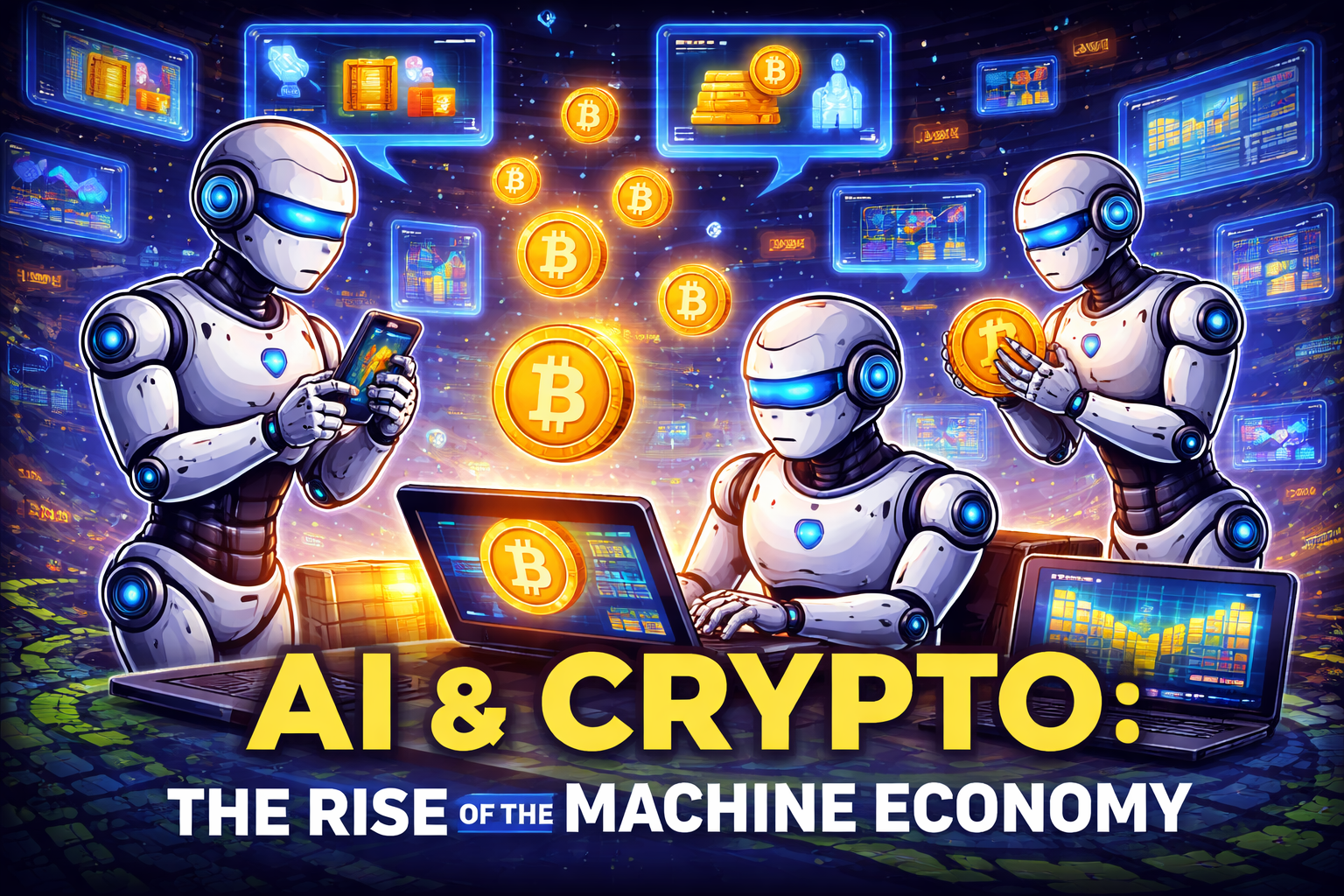
AI and Crypto Are Converging Into a Machine Economy
Artificial intelligence and blockchain technology are converging to create a new machine-driven economy where AI agents can transact autonomously using cryptocurrency. This transformation could reshape digital markets and financial infrastructure.
By Val Andrew | chainintellectcoin.com | 2026-03-18
Artificial intelligence and cryptocurrency were once viewed as separate technological revolutions. In 2026, those two systems are rapidly merging into something far more powerful: a programmable digital economy where machines can transact with each other autonomously.
The rise of AI agents capable of controlling blockchain wallets represents one of the most important shifts in the crypto ecosystem. Instead of humans manually initiating transactions, intelligent software can now pay for data, computing resources, and services automatically.
Blockchain networks such as Ethereum provide the financial infrastructure for these machine-driven transactions. Smart contracts enable automated payments, while distributed ledgers guarantee transparency and security.
This convergence could unlock entirely new digital markets.
For example, an AI system might purchase training data from another AI agent, rent GPU computing power to process that data, and then sell the resulting predictive model to businesses—all without human involvement. Each step in this process can be verified and settled on a blockchain network.
However, this emerging ecosystem also introduces new challenges. Trust becomes critical when autonomous systems interact financially. Verifying the integrity of AI-generated data, monitoring automated transactions, and maintaining transparent audit trails will become essential components of the machine economy.
This is where blockchain infrastructure becomes particularly valuable. Distributed ledgers can provide a verifiable record of AI actions, allowing developers and institutions to track how intelligent systems interact with digital assets.
Projects exploring the intersection of AI and blockchain are increasingly focused on building these trust layers. As artificial intelligence becomes more autonomous, the ability to audit and secure machine-driven financial activity will likely determine which platforms gain long-term adoption.
The next stage of the crypto industry may therefore be defined not only by human users, but also by intelligent machines participating directly in the global economy.
If that transformation continues, the real question will no longer be whether AI and crypto belong together—but how large the machine economy will ultimately become.