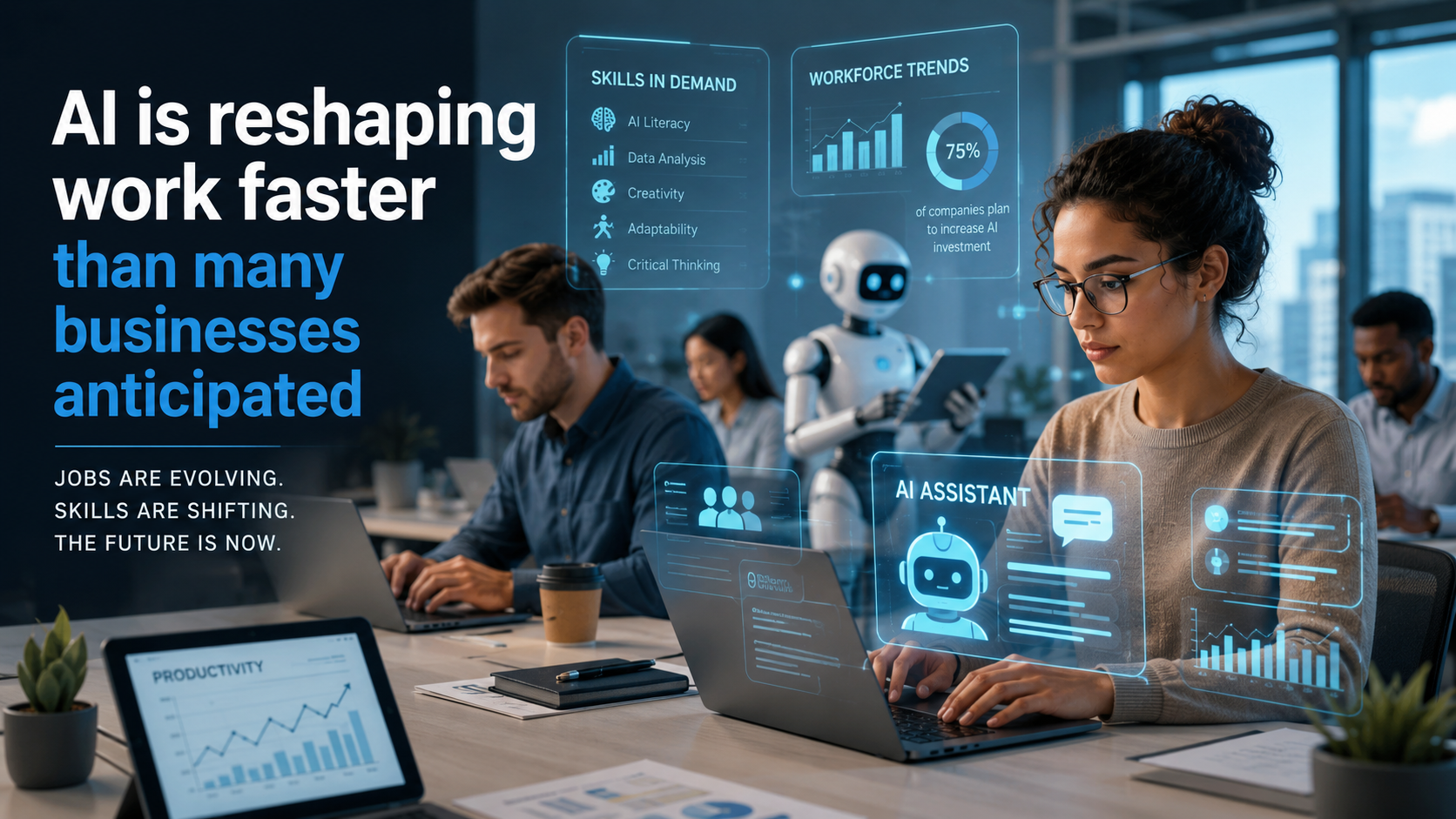
AI is reshaping work faster than many businesses anticipated
Artificial intelligence is transforming workplaces faster than many expected. Explore how AI is changing jobs, skills, productivity, and workforce development.
By Val Andrew | ChainIntellect Coin
Published June 2, 2026 • 11:00 AM UTC
Technology | Artificial Intelligence | Future of Work
Artificial intelligence is moving from experimentation to everyday business operations at a pace that few organizations predicted just a few years ago.
Across industries, companies are using AI tools to assist with research, customer support, software development, data analysis, content creation, and workflow automation. What was once considered an emerging technology is rapidly becoming part of the modern workplace.
The shift is creating new opportunities for productivity and innovation. At the same time, it is raising important questions about workforce adaptation, skills development, and the future relationship between humans and intelligent systems.
Key Takeaways
- AI adoption is accelerating across multiple industries.
- Most experts expect jobs to evolve rather than disappear entirely.
- Demand for AI-related skills is increasing.
- Workforce training may become a major economic priority.
- Businesses are increasingly focusing on augmentation rather than replacement.
AI adoption is expanding rapidly
Organizations worldwide are integrating artificial intelligence into day-to-day operations.
According to research discussed by the World Economic Forum, technological change is expected to reshape workforce requirements and increase demand for digital skills in the years ahead.
Businesses are increasingly using AI to:
- Automate repetitive tasks.
- Improve productivity.
- Analyze large datasets.
- Support customer interactions.
- Accelerate research processes.
- Assist decision-making.
Rather than operating as standalone systems, AI tools are increasingly becoming part of existing workflows.
The conversation is shifting
Early discussions about artificial intelligence often focused on job replacement.
Today, many workforce researchers describe a more complex reality.
Historically, major technological transitions have transformed jobs rather than eliminating entire categories of work. The introduction of computers, the internet, and mobile technology changed how people worked while also creating entirely new industries.
Artificial intelligence appears to be following a similar pattern.
Many organizations are deploying AI as a productivity tool that supports employees rather than replacing them.
New skills are becoming increasingly valuable
As AI adoption grows, employers are placing greater emphasis on skills that complement intelligent systems.
These include:
Critical thinking
Evaluating information, context, and outcomes remains an essential human capability.
Communication
Collaboration and relationship-building continue to play a central role in organizations.
Problem-solving
Complex business challenges often require judgment that extends beyond automation.
AI literacy
Understanding how to use, evaluate, and manage AI tools is becoming increasingly important across professions.
Experts suggest that workers who combine industry expertise with AI skills may be particularly well positioned in future labor markets.
The overlooked risk: unequal access to AI skills
One of the least discussed challenges is access.
Organizations with resources to invest in AI training may benefit from productivity improvements more quickly than those without similar opportunities.
Likewise, workers who gain experience using AI tools may develop advantages that are difficult for others to replicate.
Researchers increasingly argue that workforce development and education could become as important as the technology itself.
The long-term impact of AI may depend not only on innovation but also on how broadly access to training and digital skills is distributed.
Why researchers are paying attention
Academic institutions, policy organizations, and labor-market researchers continue to study how artificial intelligence affects employment and productivity.
Several important questions remain:
- Which professions will experience the greatest change?
- How quickly will AI adoption spread?
- Which skills will become most valuable?
- How should education systems adapt?
- What role should businesses play in workforce development?
The answers may influence economic policy, education, and business strategy for years to come.
Why it matters
Artificial intelligence is becoming one of the defining technologies of the modern economy.
For businesses, it offers opportunities to improve efficiency and competitiveness.
For workers, it presents both challenges and opportunities.
The organizations and individuals that successfully adapt to changing technology may be best positioned to benefit from future economic growth.
Understanding AI is no longer a niche technical skill. It is increasingly becoming part of professional development across industries.
Expert Perspective
Many labor-market researchers believe the future workplace will involve closer collaboration between humans and intelligent systems rather than complete automation of human roles.
While uncertainty remains regarding the speed and scale of change, most experts agree that adaptability, continuous learning, and technology literacy will become increasingly important.
The most successful organizations may be those that invest in both technology and people.
Discussion
If artificial intelligence significantly increases productivity, who should take primary responsibility for helping workers adapt?
- Employers
- Governments
- Universities
- Professional organizations
- Individuals
The answer may shape workforce development strategies throughout the coming decade.
Sources and Further Reading
- World Economic Forum research on the future of work.
- Public studies examining AI adoption and workplace productivity.
- Academic research on workforce transformation and automation.
- Industry analysis of artificial intelligence and organizational change.
About the Author
Val Andrew is the founder of ChainIntellect Coin and an independent technology researcher covering artificial intelligence, digital infrastructure, emerging technologies, workforce transformation, and long-term technology trends.
Author Profile:
https://chainintellectcoin.com/author/val-andrew/
Editorial Note
This article is part of ChainIntellect Coin News' technology coverage and is intended for informational and educational purposes only. It does not constitute financial, investment, legal, or professional advice.