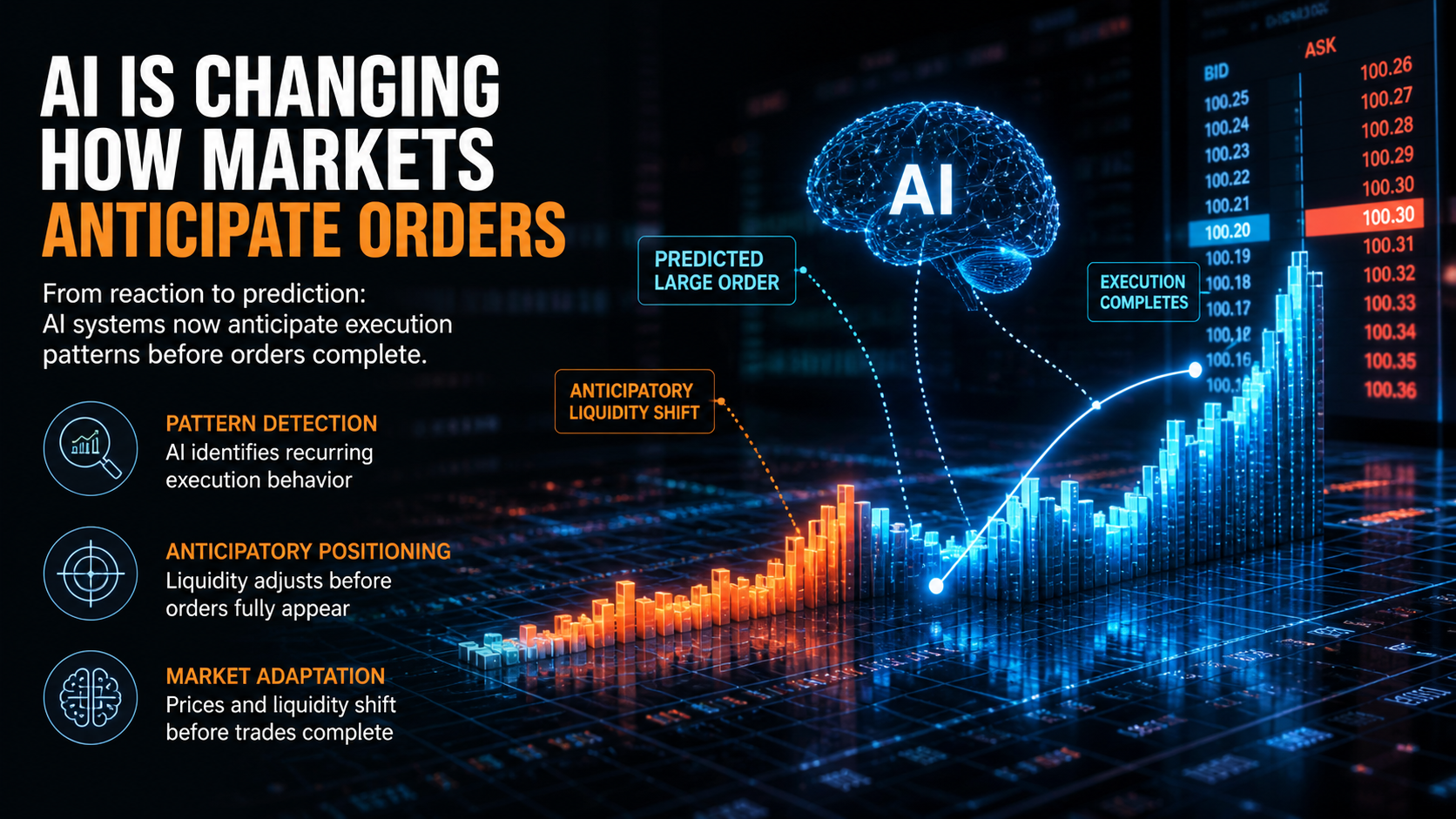
AI Is Starting to Influence Execution Predictability — And It May Change How Markets Anticipate Orders
AI is beginning to influence execution predictability in financial markets. This analysis explores how anticipatory systems reshape liquidity and execution behavior.
By Val Andrew | chainintellectcoin.com | May 14, 2026
Val Andrew covers AI systems, execution behavior, and market microstructure in financial markets.
Markets Increasingly Attempt to Anticipate Behavior Before Trades Occur
Modern electronic markets do not simply react to trades.
Increasingly, systems attempt to predict:
- order direction
- execution timing
- liquidity demand
- participant behavior
A structural shift is emerging:
AI is beginning to influence how execution patterns are anticipated before orders fully complete.
From Reactive Markets to Predictive Markets
Traditionally, markets respond after activity becomes visible:
- orders enter the market
- liquidity adjusts afterward
- prices react following execution
AI-driven systems introduce a different model:
- behavioral pattern recognition
- predictive liquidity positioning
- anticipatory execution adjustment
markets become increasingly predictive—not purely reactive
📊 The Mechanism
AI reshapes execution predictability through:
- pattern detection → systems identify recurring execution behavior
- anticipatory positioning → liquidity adjusts before orders complete
- behavioral inference → systems estimate likely market direction from partial signals
When large execution patterns emerge, systems may reposition liquidity before the full order flow becomes visible.
📉 The Constraint
Execution predictability still operates within:
- incomplete market information
- exchange transparency rules
- uncertain participant behavior
But AI-driven systems continuously optimize around these limitations—
changing how markets respond without changing the underlying exchange structure
Predictability vs Execution Quality
As markets increasingly anticipate large execution flows:
- liquidity conditions may change earlier
- pricing can shift before trades fully complete
- execution costs may rise for predictable order patterns
This creates a key tradeoff:
markets become more adaptive—but less neutral toward anticipated execution behavior
Real-World Context
Firms such as BlackRock, JPMorgan Chase, and Citadel Securities operate systems that:
- analyze execution behavior
- optimize liquidity placement dynamically
- respond to changing market patterns in real time
AI-driven prediction increasingly influences how liquidity reacts before trades fully develop.
The Deeper Insight
Markets are not only shaped by executed trades.
They are shaped by expectations of future trades.
anticipation itself becomes part of market structure—not just reaction
Bottom Line
AI is not just influencing execution speed.
It is influencing how markets anticipate behavior before execution completes.
- patterns become predictable
- liquidity reacts earlier
- execution conditions adapt before trades finish