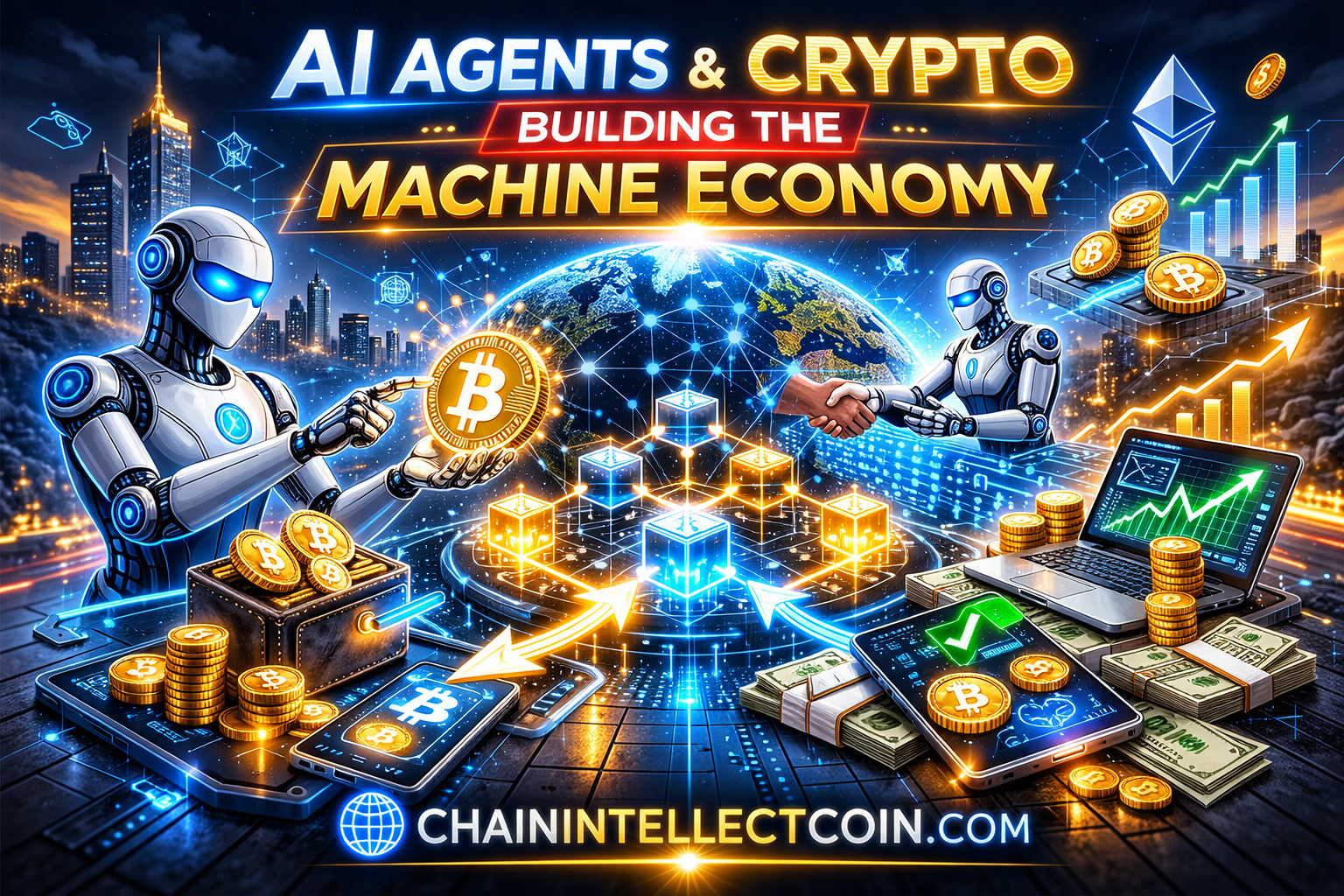
Artificial intelligence and cryptocurrency are converging to create a machine-driven economy where AI agents can transact autonomously using blockchain networks. This emerging trend could reshape digital markets in 2026.
Artificial intelligence and cryptocurrency are converging to create a machine-driven economy where AI agents can transact autonomously using blockchain networks. This emerging trend could reshape digital markets in 2026.
AI Agents and Crypto Wallets Are Quietly Building a New Machine Economy
By Val Andrew | chainintellectcoin.com | 2026-03-19
A major technological shift is unfolding at the intersection of artificial intelligence and cryptocurrency. What began as two separate innovations is now evolving into something far more powerful: a machine-driven digital economy where autonomous systems can transact directly with each other.
In 2026, developers are experimenting with AI agents that control cryptocurrency wallets, execute automated payments, and purchase digital services without human intervention. These intelligent systems can analyze information, make decisions, and interact with decentralized financial networks in real time.
This emerging model is often described as the machine economy.
AI Agents Enter the Crypto Economy
Artificial intelligence has already transformed industries such as finance, logistics, and data analysis. Now AI systems are beginning to participate directly in economic activity.
For example, an AI trading agent could purchase financial data from another AI service, pay for cloud computing resources to process that data, and automatically deploy the resulting trading strategy.
Each of these transactions can occur instantly through blockchain networks.
Platforms built on Ethereum and similar decentralized infrastructures are increasingly being used to support these automated financial interactions. Smart contracts allow transactions to occur automatically once predefined conditions are met.
This creates a digital marketplace where software systems can interact financially without relying on traditional intermediaries.
Why Blockchain Matters for Autonomous Systems
As AI systems gain the ability to transact independently, questions about trust and transparency become increasingly important. If machines are making financial decisions, there must be a reliable way to verify their actions.
Blockchain technology provides exactly that capability.
Because blockchain networks maintain permanent and tamper-resistant records, they can function as an audit layer for automated systems. Every transaction executed by an AI agent can be recorded on a decentralized ledger, creating a transparent history of activity.
This infrastructure may become essential as AI agents begin to participate more actively in digital markets.
The Emerging Trust Layer for AI
One of the biggest concerns surrounding advanced AI systems is accountability. When machines generate content, execute transactions, or analyze data, verifying the origin and integrity of that information becomes critical.
Blockchain networks offer a way to solve this problem.
By recording digital fingerprints of AI-generated data, developers can prove when information was created and whether it has been altered. This concept is increasingly described as a blockchain trust layer for artificial intelligence.
Instead of relying on centralized databases, decentralized networks can provide verifiable proof of authenticity.
Where the Opportunity Lies
For blockchain developers and infrastructure projects, the convergence of AI and crypto represents one of the most significant opportunities of the decade.
The next generation of decentralized platforms will likely focus on:
- AI data verification
- automated smart contract execution
- decentralized identity and authentication
- machine-to-machine payments
These systems could eventually support a global digital economy where intelligent machines operate alongside human participants.
The Beginning of the Machine Economy
Although this transformation is still in its early stages, the building blocks are already being deployed. AI agents are becoming more capable, blockchain networks are scaling, and decentralized financial infrastructure continues to expand.
Together, these technologies are forming the foundation for a new economic model.
The machine economy may not replace traditional markets overnight, but its influence is likely to grow as artificial intelligence becomes more autonomous.
The real question is no longer whether AI and crypto will intersect—but how large this new digital economy will ultimately become.