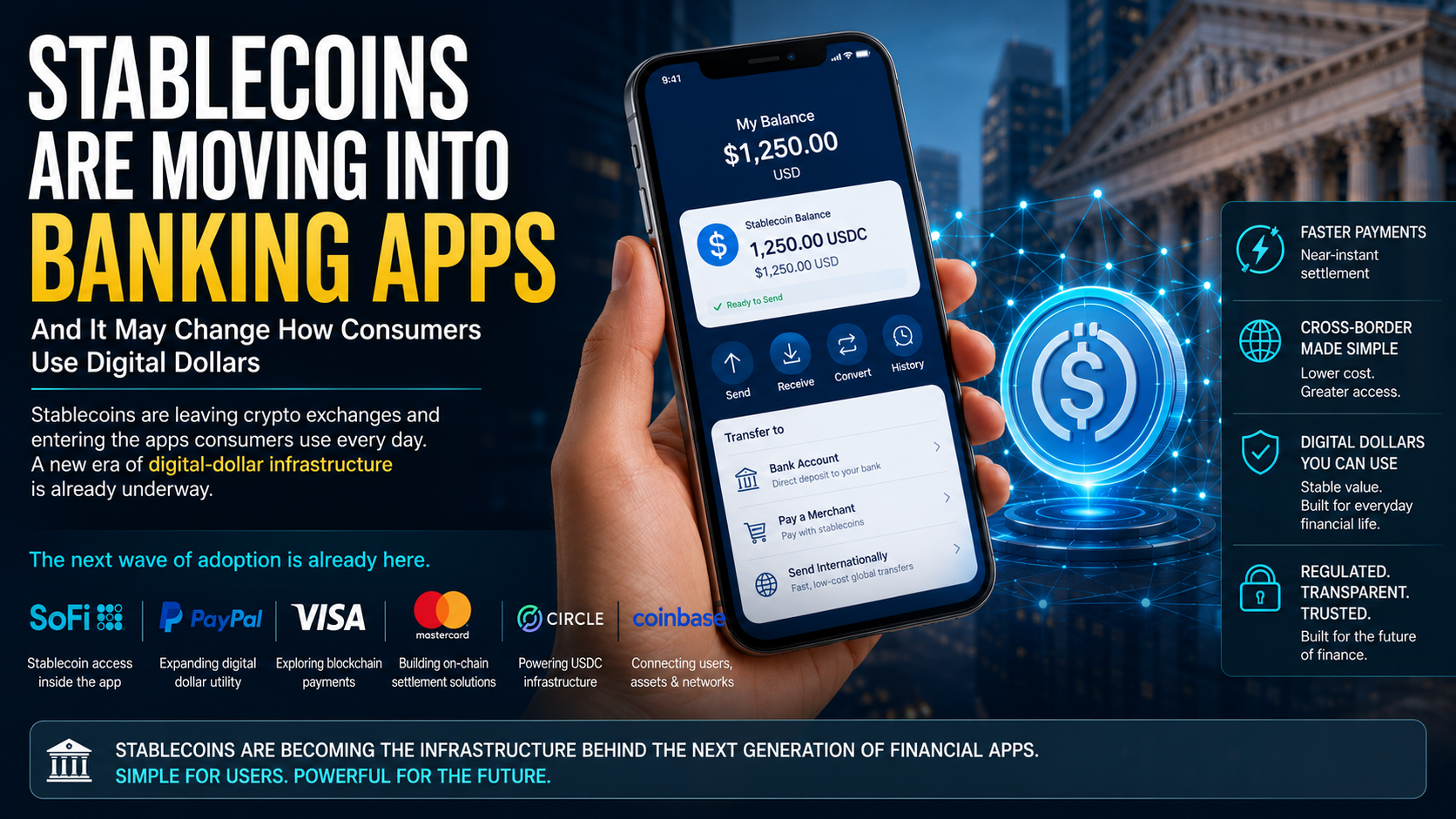
Stablecoins Are Moving Into Banking Apps — And It May Change How Consumers Use Digital Dollars
Stablecoins are moving into banking apps and fintech platforms. This analysis explores how digital dollars may become mainstream financial infrastructure without consumers needing to use crypto directly.
By Val Andrew | chainintellectcoin.com | May 30, 2026
Val Andrew covers digital-asset infrastructure, fintech systems, and financial market evolution.
Stablecoins Are Leaving Crypto Exchanges
Stablecoins were once mostly used inside crypto trading platforms.
That is changing.
A new phase is emerging as banks and fintech platforms begin bringing stablecoins closer to everyday financial apps.
Recent moves from firms such as SoFi, PayPal, Visa, Mastercard, Circle, and Coinbase show that stablecoins are increasingly being tested as payment, settlement, and digital-dollar infrastructure—not just crypto trading tools.
The next stablecoin adoption wave may happen inside financial apps consumers already use.
From Crypto Utility to Banking Infrastructure
Historically, stablecoins helped traders move value between crypto assets.
Now, financial firms are exploring stablecoins for:
- faster transfers
- cross-border payments
- programmable dollar movement
- digital settlement
- tokenized financial products
This represents a major shift:
stablecoins are moving from exchange liquidity tools toward consumer-facing financial infrastructure.
📊 The Mechanism
Stablecoin adoption expands through three layers:
1. App-Based Access
Consumers may access stablecoins through regulated financial apps rather than crypto-native wallets.
2. Payment Integration
Stablecoins can be connected to payment networks, merchants, and transfer systems.
3. Settlement Infrastructure
Stablecoins may support faster settlement between platforms, institutions, and digital asset networks.
The key change is convenience.
If stablecoins become available inside trusted financial apps, users may not need to understand blockchain infrastructure to use blockchain-based value transfer.
Real-World Context
SoFi recently made its stablecoin available to customers through its app, marking a notable step toward consumer-facing stablecoin access. PayPal has also pushed stablecoin adoption through PYUSD, while Visa and Mastercard continue exploring blockchain-based payment and settlement systems.
Meanwhile, Circle remains one of the most important stablecoin issuers through USDC, and Coinbase continues to operate as a major distribution and infrastructure platform for stablecoin activity. Regulators and central banks are also paying closer attention as stablecoins move closer to mainstream payment systems.
The Contrarian View
Many people assume stablecoin adoption requires consumers to become crypto users.
That may not be true.
The more likely path may be:
- stablecoins embedded into apps
- blockchain hidden in the background
- payments presented in familiar dollar terms
- regulated platforms handling custody and conversion
Consumers may use stablecoin infrastructure without thinking of it as “crypto.”
That is how many financial technologies become mainstream: the infrastructure disappears behind the user experience.
The Risk
Stablecoins still face major challenges:
- reserve transparency
- regulatory oversight
- issuer concentration
- cybersecurity risk
- consumer protection concerns
If stablecoins become part of mainstream banking apps, these risks become more important—not less.
The question is no longer only whether stablecoins are useful.
It is whether stablecoin infrastructure can remain transparent, resilient, and properly supervised at scale.
The Strategic Implication
If stablecoins continue moving into consumer-facing financial platforms:
- banks may compete directly with crypto-native payment systems
- fintech apps may become digital-dollar gateways
- cross-border transfers could become faster
- tokenized finance may become easier to access
- payment networks may integrate more blockchain settlement tools
This would shift stablecoins from a crypto-market feature into a broader financial infrastructure layer.
The Deeper Insight
Stablecoin adoption may not arrive as a dramatic consumer revolution.
It may arrive quietly through banking apps, payment platforms, and fintech interfaces.
The most important stablecoin shift may be not that consumers choose crypto—but that financial apps begin using crypto infrastructure underneath familiar products.
That would make stablecoins less visible as crypto assets and more important as financial rails.
🧭 Where ChainIntellect Coin Fits Into the Broader Shift
Projects such as ChainIntellect Coin reflect the broader movement toward blockchain-native infrastructure, where programmable settlement, intelligent coordination, and digital financial systems increasingly influence how value moves across modern networks.
As stablecoins, tokenized assets, and AI-enabled financial infrastructure expand, ecosystems focused on intelligent blockchain coordination may become increasingly relevant to the next phase of digital finance.