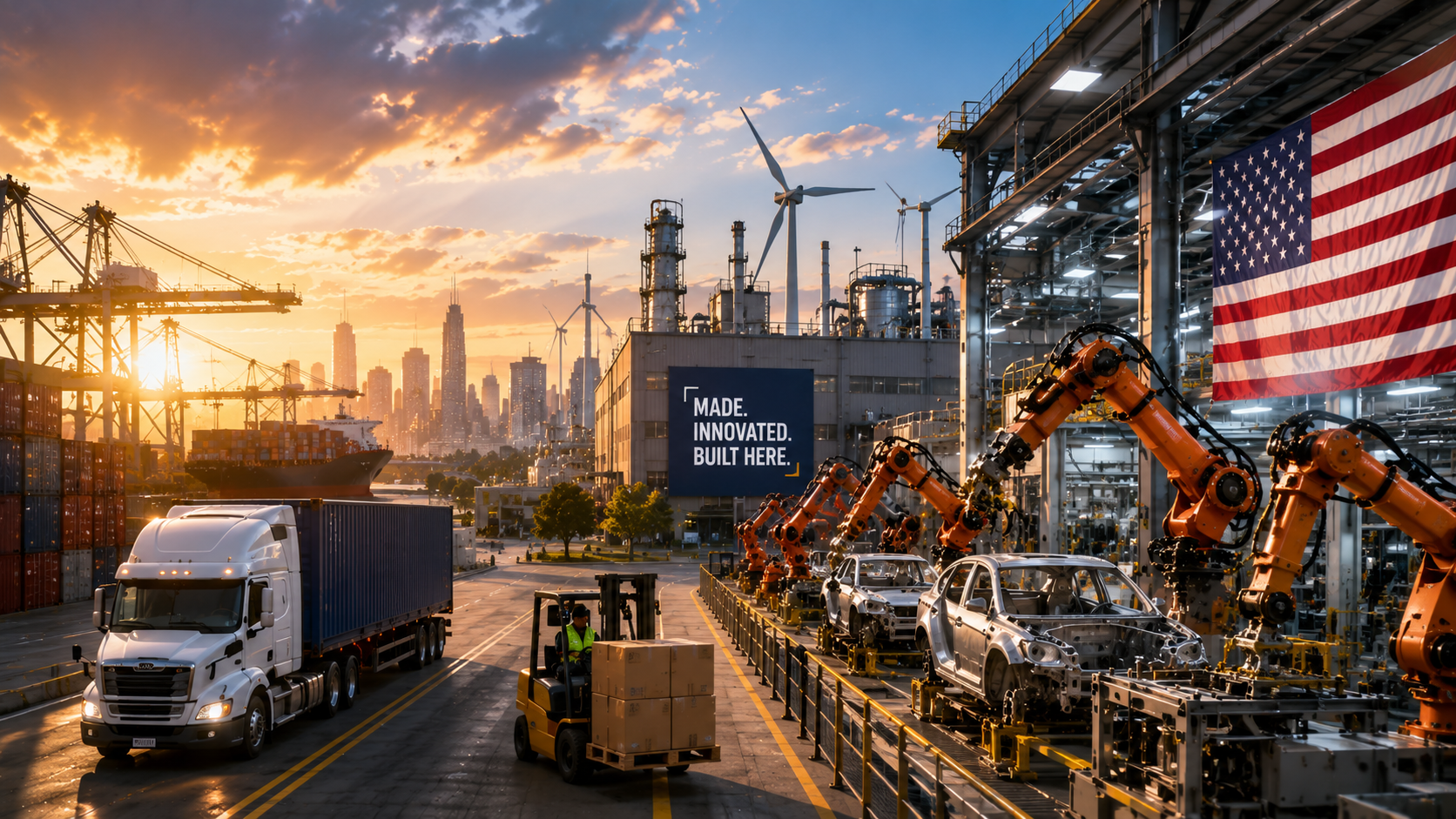
The Factory Comeback: Why Manufacturing Is Becoming Strategic Again
Manufacturing is returning to the center of economic strategy. This analysis explores why governments, investors, and major companies are treating industrial capacity as a critical competitive advantage in the modern economy.
By Val Andrew | chainintellectcoin.com | June 7, 2026
Val Andrew covers economic infrastructure, technology, global trade, and industrial transformation.
The Economic Shift Happening Behind the Headlines
For decades, many advanced economies focused on services, software, finance, and digital innovation.
Manufacturing increasingly moved overseas.
Global supply chains expanded.
Production became more international.
This model helped reduce costs and improve efficiency.
Yet over the past several years, something has changed.
Governments, corporations, and investors are paying renewed attention to manufacturing capacity.
Factories are once again becoming strategic assets.
This raises an important question:
Why is manufacturing becoming a priority again in an increasingly digital economy?
The answer may reveal one of the most important economic shifts of the decade.
The End of "Efficiency Above Everything"
For years, businesses optimized supply chains primarily for efficiency.
The goals were straightforward:
- lower costs
- global sourcing
- lean inventories
- maximum productivity
Recent disruptions exposed vulnerabilities in this model.
Events such as:
- supply-chain disruptions
- geopolitical tensions
- semiconductor shortages
- logistics bottlenecks
demonstrated that efficiency alone may not be enough.
Increasingly, resilience is becoming just as important as efficiency.
This represents a significant shift in economic thinking.
The Historical Pattern
History shows that periods of geopolitical uncertainty often change industrial priorities.
Countries have repeatedly invested in strategic industries when governments and businesses viewed certain capabilities as essential to long-term economic security.
Examples include:
- energy infrastructure
- transportation networks
- telecommunications systems
- semiconductor production
Manufacturing is increasingly being viewed through a similar lens.
The discussion is no longer only about economics.
It is also about resilience.
Real-World Context
Major companies continue investing heavily in manufacturing expansion and supply-chain modernization.
Examples include:
- Intel expanding semiconductor manufacturing
- TSMC investing in advanced chip production facilities
- Tesla expanding manufacturing capacity
- Apple diversifying production networks
- Samsung Electronics investing in advanced manufacturing infrastructure
Meanwhile, governments across North America, Europe, and Asia are supporting industrial investment through incentives, infrastructure spending, and strategic economic programs.
Manufacturing is increasingly being discussed as national infrastructure rather than simply private-sector activity.
A Practical Example
Semiconductors provide one of the clearest examples.
Modern economies depend on advanced chips for:
- smartphones
- vehicles
- healthcare equipment
- industrial systems
- artificial intelligence
When semiconductor shortages emerged, the effects spread far beyond technology companies.
Automotive production slowed.
Consumer electronics faced delays.
Industrial output was affected.
The episode demonstrated how manufacturing capacity can influence entire economies.
The Contrarian View
Many people assume digital economies rely less on physical production.
The evidence increasingly suggests the opposite.
The more advanced economies become, the more dependent they often become on sophisticated manufacturing infrastructure.
Cloud computing depends on servers.
Artificial intelligence depends on semiconductors.
Electric vehicles depend on battery production.
Digital transformation still requires physical infrastructure.
The digital economy remains connected to the industrial economy.
The Global Competition
Countries increasingly view manufacturing capability as a strategic advantage.
Governments are investing in:
- semiconductor facilities
- energy infrastructure
- industrial automation
- advanced materials
- workforce development
This creates a new form of economic competition.
Future growth may depend not only on innovation but also on the ability to manufacture critical technologies at scale.
The race is no longer only about invention.
It is increasingly about production.
The Risk
Manufacturing expansion introduces challenges.
These include:
- workforce shortages
- infrastructure costs
- environmental considerations
- supply-chain dependencies
- capital intensity
Building industrial capacity requires long-term planning and significant investment.
Results are measured in years rather than quarters.
The Deeper Insight
For much of the digital era, economic discussions focused on software, services, and information.
The coming decade may bring renewed appreciation for physical production.
Factories are not simply places where products are assembled.
They are increasingly becoming strategic infrastructure that supports technological innovation, economic resilience, and national competitiveness.
The most important economic story may not be the return of manufacturing itself. It may be the recognition that even the most advanced digital economies still depend on the ability to build things in the physical world.
Where ChainIntellect Coin Fits Into the Broader Shift
Projects such as ChainIntellect Coin reflect the broader movement toward intelligent infrastructure, where automation, interoperability, data coordination, and digital systems increasingly support complex industrial and economic environments.
As manufacturing, AI, logistics, and infrastructure become more connected, intelligent digital ecosystems may play a growing role in coordinating future economic activity.