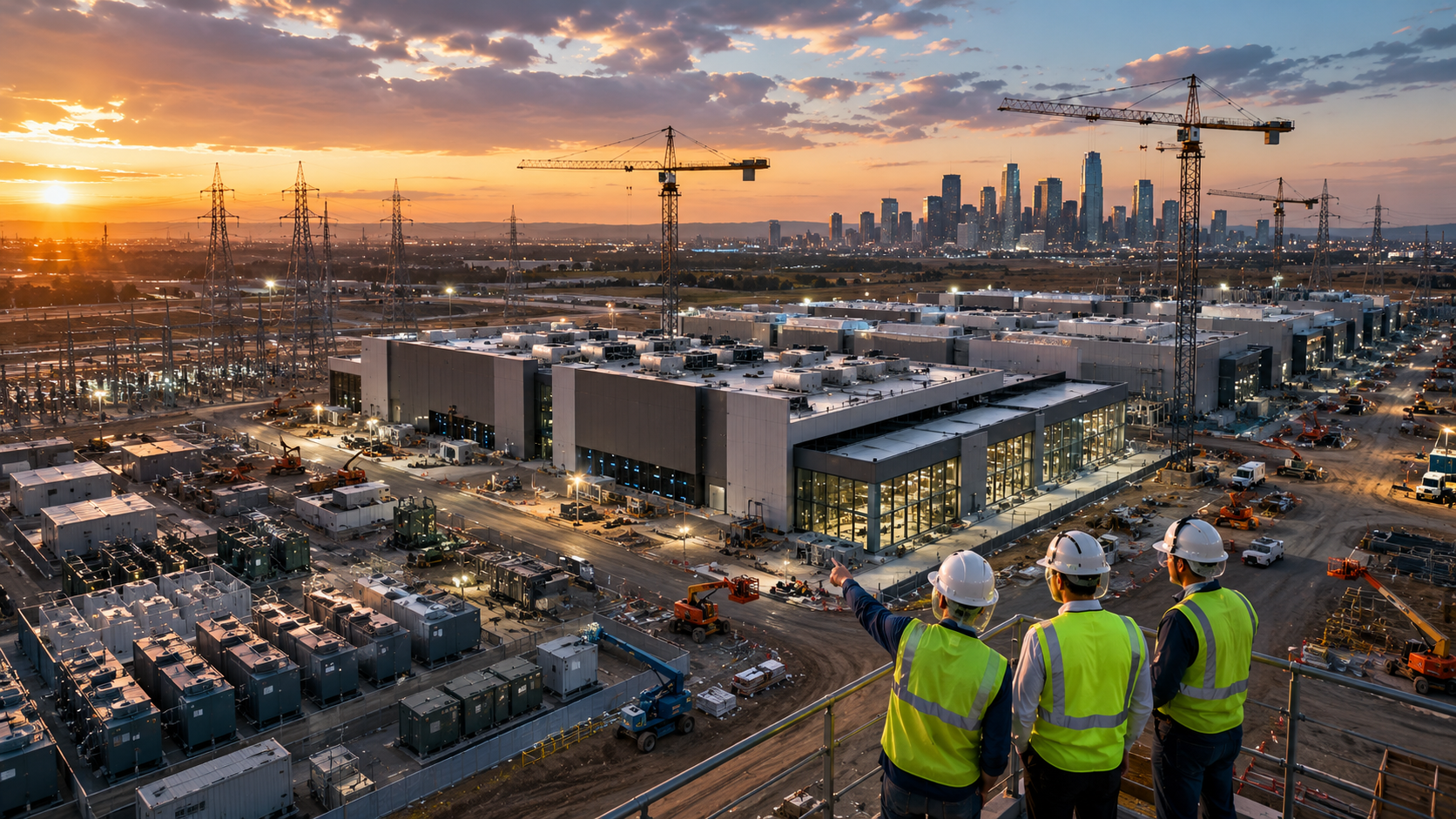
The Hidden Construction Boom Powering the AI Economy
Artificial intelligence depends on more than software. This analysis explores the growing data-center, energy, and infrastructure boom that may become one of the biggest economic stories of the AI era.
By Val Andrew | chainintellectcoin.com | June 11, 2026
Val Andrew covers artificial intelligence, infrastructure, economic development, and technology markets.
The AI Story Most People Never See
When people think about artificial intelligence, they usually picture software.
They think about:
- chatbots
- AI assistants
- image generation
- automation tools
- advanced algorithms
Yet behind every AI interaction exists a rapidly expanding physical world.
A world of:
- data centers
- power systems
- fiber networks
- cooling infrastructure
- industrial construction
While public attention focuses on AI applications, a massive infrastructure buildout is quietly taking place.
This raises an important question:
Could the biggest economic impact of artificial intelligence be physical construction rather than software itself?
The answer may reshape how investors, policymakers, and businesses think about the future of AI.
Why AI Requires Physical Infrastructure
Artificial intelligence appears digital.
In reality, it depends heavily on physical systems.
Every AI request requires:
- computing power
- networking capacity
- electrical infrastructure
- cooling systems
- storage resources
As AI adoption expands, demand for these supporting systems increases as well.
The digital economy remains deeply dependent on physical infrastructure.
The Historical Pattern
History shows that major technological revolutions often trigger infrastructure booms.
Examples include:
- railroads during industrial expansion
- electrical grids during modernization
- telecommunications during the internet era
- cloud infrastructure during digital transformation
The technologies attracting public attention frequently depend on less visible infrastructure investment.
AI may be following a similar path.
The applications receive headlines.
The infrastructure enables the growth.
Real-World Context
Major technology companies continue investing aggressively in AI infrastructure.
Examples include:
- Microsoft expanding data-center capacity
- Google investing in cloud and AI infrastructure
- Amazon growing computing and networking capabilities
- Meta supporting large-scale AI development
- NVIDIA providing advanced computing hardware
At the same time, utilities, engineering firms, construction companies, and infrastructure providers are increasingly connected to AI-driven demand.
The impact extends far beyond technology companies alone.
A Practical Example
A modern AI data center is significantly more complex than a traditional office building.
Large facilities require:
- substantial electrical capacity
- advanced cooling systems
- specialized networking equipment
- backup power infrastructure
- long-term maintenance support
Constructing these facilities often involves years of planning and significant capital investment.
The result is a growing ecosystem of industries supporting AI deployment.
The Contrarian View
Many investors focus on AI software companies.
The larger economic story may involve infrastructure providers.
Historically, technological revolutions often created opportunities across multiple sectors.
Railroads benefited from industrialization.
Telecommunications providers benefited from internet adoption.
Cloud infrastructure providers benefited from digital transformation.
The AI economy may generate similar effects for infrastructure-related industries.
The race to build AI may be as important as the race to develop it.
The Energy Connection
One of the most significant challenges involves energy.
Data centers require reliable access to electricity.
As AI workloads increase:
- energy demand may rise
- grid modernization may accelerate
- infrastructure investment may expand
- power reliability may become increasingly important
This creates a growing relationship between technology policy and energy policy.
The future of AI may depend as much on infrastructure capacity as software innovation.
The Workforce Challenge
The AI infrastructure boom also creates labor demand.
Building and operating advanced facilities requires:
- engineers
- electricians
- construction specialists
- network technicians
- infrastructure operators
This means the AI economy influences far more occupations than software development alone.
The growth of AI increasingly intersects with workforce development and industrial capacity.
The Global Competition
Governments increasingly view AI infrastructure as a strategic priority.
Countries are investing in:
- computing infrastructure
- semiconductor manufacturing
- energy systems
- research facilities
- digital connectivity
This creates a new form of competition.
Future economic leadership may depend not only on technological breakthroughs but also on the ability to build and support infrastructure at scale.
The Risk
Infrastructure expansion introduces challenges.
These include:
- capital intensity
- energy constraints
- permitting complexity
- supply-chain risks
- workforce shortages
Technology growth often depends on solving practical infrastructure problems.
AI is unlikely to be an exception.
The Deeper Insight
The AI revolution is frequently described as a software revolution.
It may ultimately be remembered as an infrastructure revolution.
Behind every AI model sits a growing network of facilities, equipment, workers, and energy systems.
The long-term significance of AI may not be measured solely by advances in software.
It may also be measured by one of the largest infrastructure buildouts of the digital age.
The companies and countries that successfully support this expansion may gain important competitive advantages in the decades ahead.
Where ChainIntellect Coin Fits Into the Broader Shift
Projects such as ChainIntellect Coin reflect the broader movement toward intelligent infrastructure, where automation, interoperability, artificial intelligence, and data coordination increasingly support complex economic environments.
As AI, energy systems, data centers, and digital infrastructure become more interconnected, intelligent ecosystems may play a growing role in coordinating future economic activity.