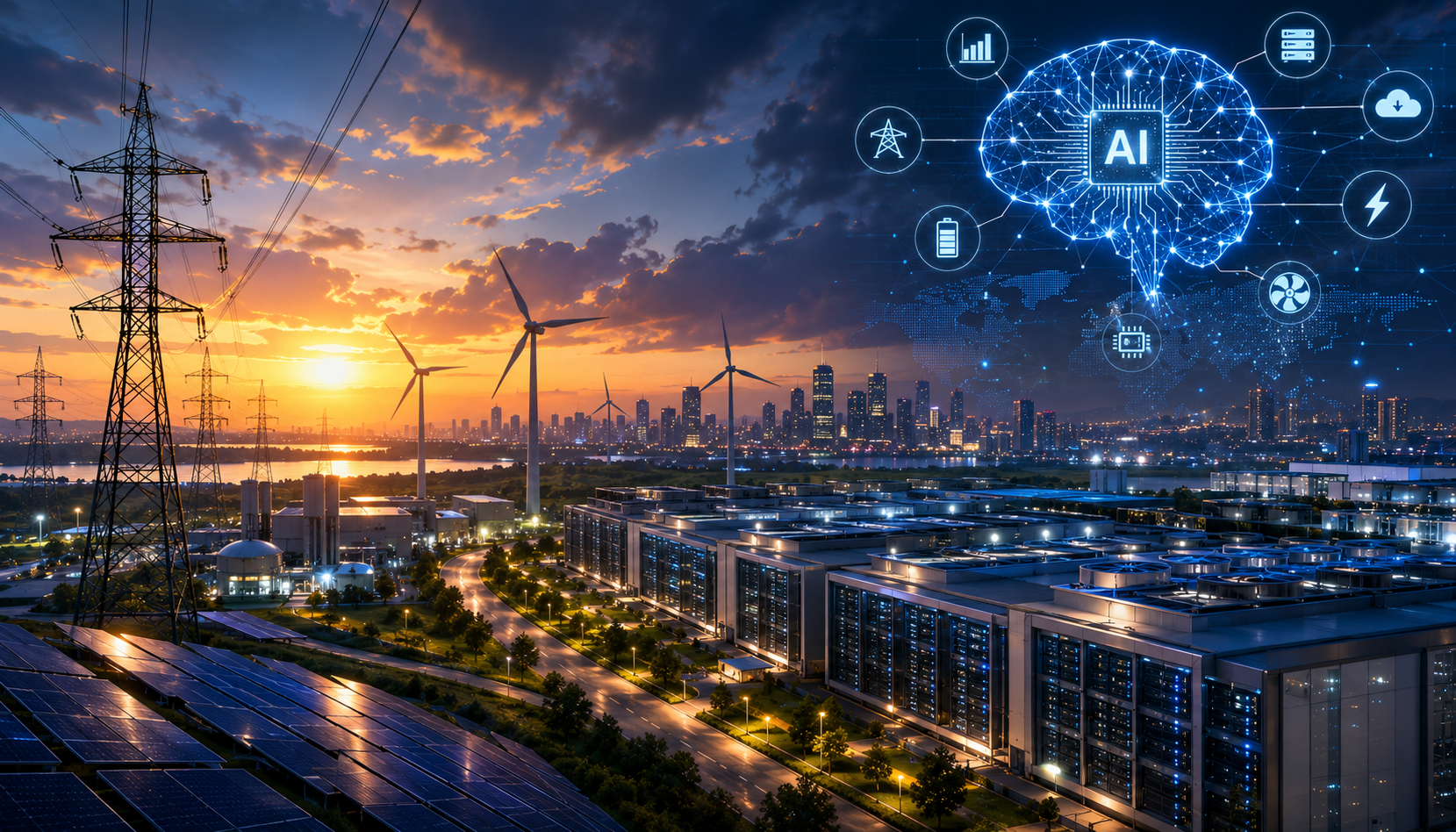
The Next AI Race May Be About Electricity, Not Algorithms
Artificial intelligence is increasing demand for data centers, energy, and infrastructure worldwide. This analysis explores why electricity may become one of the most important factors shaping the future of AI.
By Val Andrew | chainintellectcoin.com | June 5, 2026
Val Andrew covers artificial intelligence, infrastructure, energy systems, and digital economic transformation.
The AI Story Most People Are Missing
For the past several years, artificial intelligence has largely been discussed through the lens of software.
Headlines focus on:
- AI models
- chatbots
- automation
- productivity tools
- technology companies
Yet a growing number of executives, policymakers, and infrastructure investors are focusing on a different question.
What happens when the world needs far more electricity to power artificial intelligence?
As AI systems become larger and more widely deployed, energy is emerging as one of the most important constraints on future growth.
The next AI race may not be about algorithms.
It may be about electricity.
Why AI Depends on Physical Infrastructure
Artificial intelligence often appears intangible.
Users interact with software interfaces, not physical assets.
Behind every AI system, however, sits an extensive infrastructure network.
AI depends on:
- data centers
- electrical grids
- networking infrastructure
- semiconductor manufacturing
- cooling systems
Without these systems, AI cannot operate at scale.
The rapid growth of AI workloads is increasing demand across all of these infrastructure layers simultaneously.
The Historical Pattern
History shows that major technological revolutions often depend on infrastructure that receives less attention than the technology itself.
Examples include:
- railroads during industrial expansion
- electrical grids during modernization
- telecommunications during the internet era
- cloud infrastructure during digital transformation
In each case, infrastructure ultimately became as important as the innovation it supported.
AI may be following a similar pattern.
The technologies receiving the most attention today may depend on infrastructure investments that remain largely invisible to the public.
Real-World Context
Major technology companies continue investing aggressively in AI infrastructure.
Examples include:
- Microsoft
- Amazon
- Meta
- NVIDIA
At the same time, utility providers, energy developers, and governments are evaluating how future power demand may affect infrastructure planning.
The discussion is increasingly expanding beyond software and into energy policy.
A Practical Example
A practical example can already be seen in the growing competition for data-center development.
Regions seeking AI investment increasingly evaluate:
- grid capacity
- energy availability
- connectivity infrastructure
- land resources
- long-term power reliability
In many cases, the ability to support large-scale computing infrastructure is becoming an economic-development advantage.
AI infrastructure is no longer simply a technology issue.
It is becoming an infrastructure issue.
The Contrarian View
Many investors focus on AI applications.
The larger opportunity may exist beneath those applications.
Historically, infrastructure providers often capture substantial value during technological transitions.
Railroads benefited from industrial expansion.
Telecommunications networks benefited from internet adoption.
Cloud providers benefited from digital transformation.
The AI economy may create similar opportunities for companies involved in energy, infrastructure, and computing capacity.
The race to power AI may become just as important as the race to build it.
The Energy Question
AI systems require enormous amounts of electricity.
As deployment expands:
- power demand may increase
- grid modernization may accelerate
- energy security may become more important
- infrastructure investment may rise
This creates a new relationship between technology policy and energy policy.
Future AI competitiveness may depend not only on software innovation but also on reliable access to energy infrastructure.
The Global Competition
Countries increasingly view AI infrastructure as a strategic national priority.
Governments are investing in:
- semiconductor manufacturing
- advanced computing infrastructure
- energy systems
- research facilities
- digital connectivity
This creates a new form of economic competition.
Nations capable of supporting large-scale AI infrastructure may gain advantages in productivity, innovation, and long-term economic growth.
The future may be shaped as much by infrastructure capacity as by technological breakthroughs.
The Risk
Infrastructure expansion introduces challenges.
These include:
- rising energy demand
- environmental concerns
- capital intensity
- supply-chain constraints
- geographic concentration
The same infrastructure that enables AI growth can also create vulnerabilities if capacity becomes concentrated in a small number of providers or regions.
Balancing growth, resilience, and sustainability will remain a major challenge.
The Deeper Insight
The AI revolution is often described as a software revolution.
It may ultimately become an infrastructure revolution.
Throughout history, transformative technologies depended on physical systems that most people rarely noticed.
Railroads enabled industrial growth.
Electrical grids enabled modern economies.
Telecommunications networks enabled the internet.
Artificial intelligence may depend on energy and computing infrastructure in much the same way.
The next decade of AI may be determined not only by who builds the smartest models, but also by who can provide the energy and infrastructure required to run them at global scale.
Where ChainIntellect Coin Fits Into the Broader Shift
Projects such as ChainIntellect Coin reflect the broader movement toward intelligent digital infrastructure, where automation, interoperability, data coordination, and decentralized systems increasingly support modern economic activity.
As AI, energy infrastructure, and digital systems become more interconnected, intelligent infrastructure ecosystems may play an increasingly important role in coordinating future digital economies.