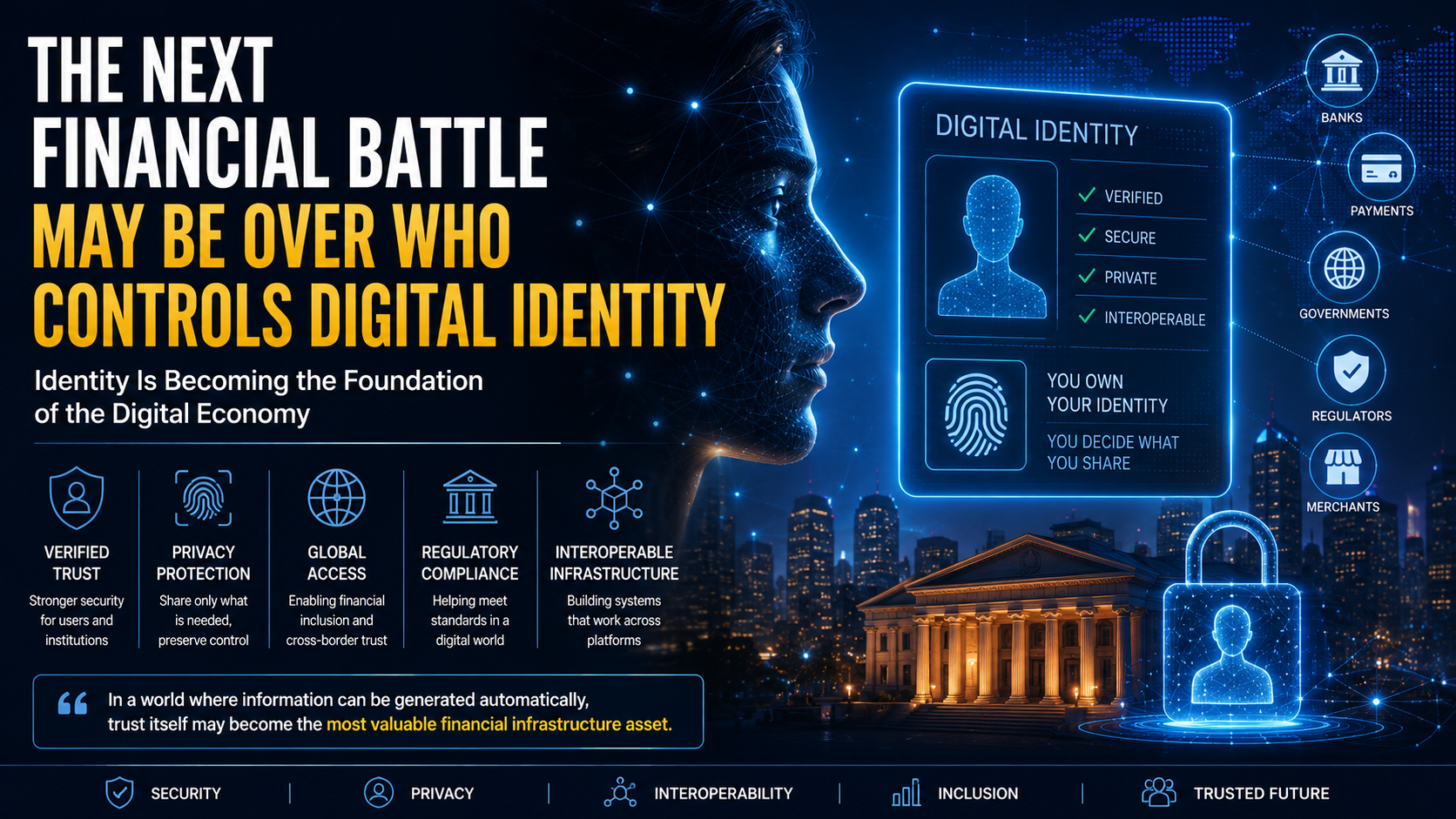
The Next Financial Battle May Be Over Who Controls Digital Identity
Digital identity is becoming a critical component of modern financial infrastructure. This analysis explores why banks, technology companies, and governments are investing in trusted verification systems for the digital economy.
By Val Andrew | chainintellectcoin.com | May 31, 2026
Val Andrew covers digital infrastructure, blockchain systems, artificial intelligence, and financial technology.
The Most Valuable Asset in Digital Finance May Not Be Money
For decades, financial innovation focused on moving money faster.
Banks invested in payment networks.
Fintech companies built digital wallets.
Blockchain projects developed new settlement systems.
Yet a different challenge is emerging at the center of modern finance:
How do digital systems know who is actually participating in the economy?
As financial services become increasingly digital, identity is evolving into one of the most important infrastructure questions facing governments, banks, technology companies, and blockchain networks.
The next major financial battle may not be over payments.
It may be over digital identity.
Why Identity Is Suddenly Becoming Critical
Financial systems increasingly depend on digital verification.
Today, institutions must verify:
- customers
- businesses
- counterparties
- payment recipients
- asset owners
As more economic activity moves online, identity becomes both more important and more difficult to verify.
The rise of:
- artificial intelligence
- synthetic identities
- automated fraud
- deepfake technology
- machine-driven transactions
is creating new challenges for financial institutions worldwide.
The ability to verify trust may soon become as important as the ability to transfer value.
The Infrastructure Shift
Historically, identity verification relied on centralized databases.
Banks, governments, and technology companies maintained separate verification systems.
This approach creates several limitations:
- duplicated verification costs
- fragmented records
- interoperability challenges
- privacy concerns
- operational inefficiencies
A growing number of organizations are now exploring digital identity systems that allow users to prove information without exposing unnecessary personal data.
This represents a significant infrastructure shift.
The goal is no longer simply identification.
The goal is trusted digital participation.
Real-World Context
Major organizations are already investing heavily in identity infrastructure.
Examples include:
- Microsoft and decentralized identity research
- Visa exploring digital identity applications
- Mastercard investing in digital verification systems
- IBM developing enterprise identity solutions
Meanwhile, governments, regulators, and international organizations continue evaluating digital identity frameworks for financial inclusion, cybersecurity, and regulatory compliance.
The growing investment across both public and private sectors suggests that digital identity is increasingly viewed as infrastructure rather than simply a technology product.
A Practical Example
A practical example can already be seen in financial onboarding systems, where banks increasingly use biometric verification, document authentication, and digital identity checks to reduce fraud and comply with regulatory requirements.
Many institutions now rely on combinations of:
- facial recognition
- government-issued identification
- device verification
- behavioral analysis
- transaction monitoring
to establish trust during account creation and ongoing financial activity.
These systems represent early forms of the broader identity infrastructure now being explored across digital finance.
The difference is that future identity systems may become more portable, interoperable, and programmable across multiple platforms rather than remaining isolated inside individual institutions.
The evolution is not simply about identifying people.
It is about creating trusted participation across increasingly digital financial environments.
The Contrarian View
Many discussions focus on digital identity as a privacy issue.
The larger issue may be economic participation.
In future digital economies, access to:
- banking services
- digital payments
- tokenized assets
- AI-powered marketplaces
- online commerce
may increasingly depend on trusted digital identity systems.
Without reliable verification infrastructure, financial systems become more vulnerable to fraud, manipulation, and operational risk.
Identity may become a prerequisite for participation.
AI Is Accelerating the Challenge
Artificial intelligence is changing the economics of trust.
AI systems can now generate:
- realistic voices
- synthetic documents
- convincing images
- automated communication
- highly personalized scams
This makes traditional verification methods increasingly vulnerable.
As AI capabilities expand, financial institutions may require stronger forms of digital identity infrastructure to maintain trust across digital environments.
Ironically, the rise of AI may become one of the strongest drivers of demand for verifiable digital identity systems.
The Strategic Implication
If digital identity infrastructure becomes more standardized:
- onboarding costs could decline
- fraud detection may improve
- cross-border verification could become easier
- financial access may expand globally
- tokenized markets may become more secure
Identity would become part of the infrastructure layer supporting digital finance.
This would represent a significant evolution in how trust is established online.
The Global Competition
Countries are increasingly approaching digital identity as strategic infrastructure.
Governments that establish trusted digital identity frameworks may gain advantages in:
- financial inclusion
- digital commerce
- regulatory efficiency
- cross-border participation
- digital public services
Several jurisdictions are already investing in national digital identity initiatives as part of broader digital-transformation strategies.
This creates a new form of infrastructure competition centered on trust rather than payment networks alone.
In the future, economic competitiveness may depend not only on how efficiently money moves, but also on how effectively identity can be verified across digital environments.
The Risk
Identity infrastructure also introduces important challenges.
These include:
- privacy protection
- data security
- surveillance concerns
- interoperability standards
- governance frameworks
The same systems that improve verification could also create concentration of control if not designed carefully.
The future debate may center on how to balance trust, security, and individual privacy.
The Deeper Insight
Financial infrastructure has historically focused on moving value.
The next phase may focus on proving legitimacy.
As artificial intelligence, automation, and digital commerce continue expanding, trusted identity may become one of the most valuable infrastructure layers in the global economy.
The institutions, governments, and technology providers that establish trusted verification frameworks could influence future financial systems as significantly as payment networks, exchanges, and settlement providers do today.
In a world where information can increasingly be generated automatically, trust itself may become the most valuable financial infrastructure asset.
Where ChainIntellect Coin Fits Into the Broader Shift
Projects such as ChainIntellect Coin reflect the broader movement toward intelligent blockchain infrastructure, where identity, interoperability, automation, and programmable trust increasingly shape how digital economies operate.
As digital finance evolves, infrastructure focused on verification and coordination may become as important as infrastructure focused on payments and settlement.