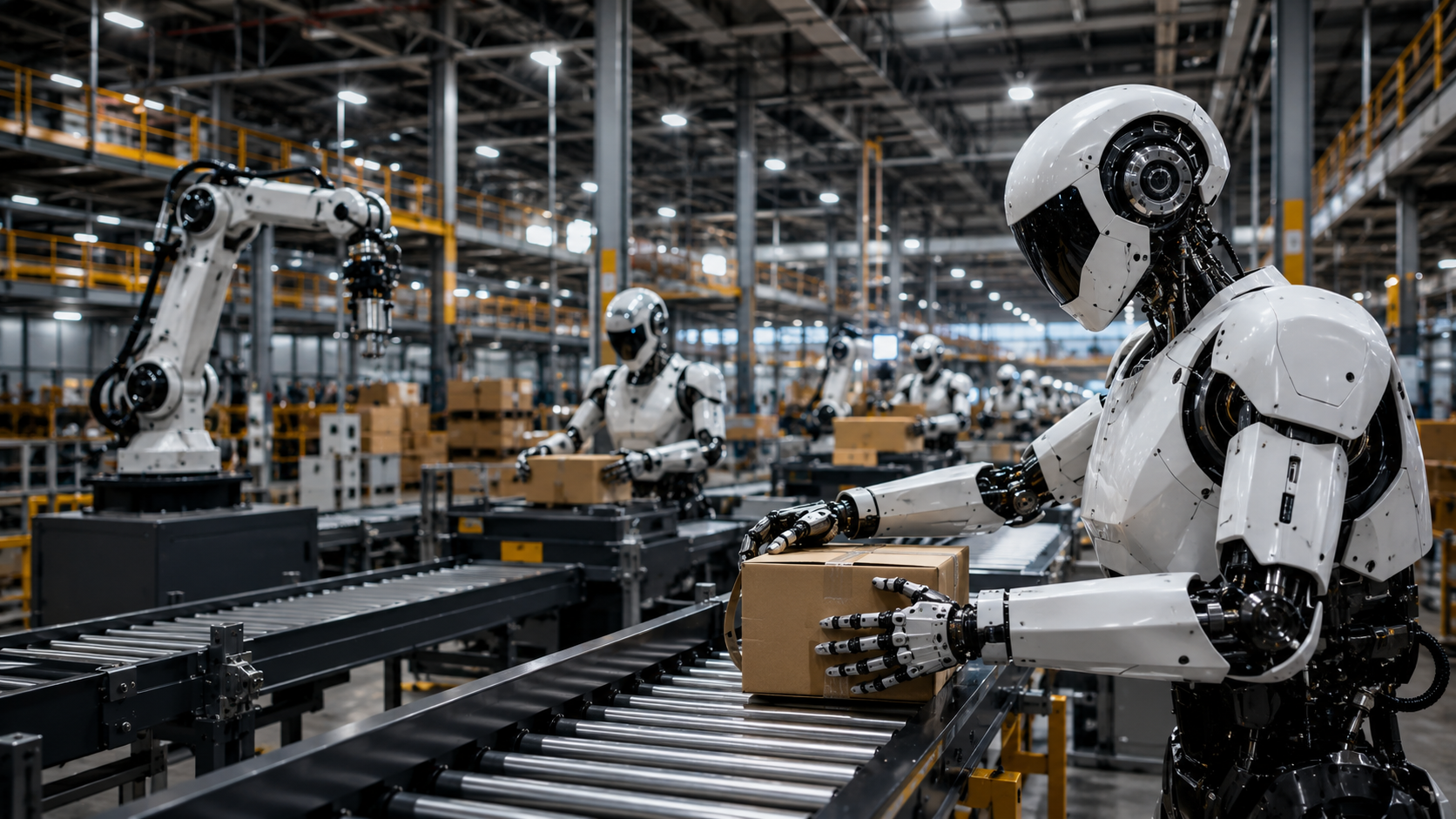
The Robot Economy Is Arriving Faster Than Most People Realize
Robotics is expanding beyond factories into logistics, healthcare, manufacturing, and infrastructure. This analysis explores how intelligent machines may reshape productivity, competitiveness, and economic growth in the coming decade.
By Val Andrew | chainintellectcoin.com | June 10, 2026
Val Andrew covers artificial intelligence, automation, economic infrastructure, and industrial transformation.
The Automation Story Is Changing
For years, discussions about automation focused primarily on software.
Headlines centered on:
- artificial intelligence
- chatbots
- machine learning
- digital productivity tools
But a quieter transformation is now accelerating.
Robots are becoming smarter.
Sensors are becoming cheaper.
Computing power continues expanding.
Artificial intelligence is increasingly being integrated into physical machines.
As a result, automation is moving beyond screens and into the physical economy.
This raises an important question:
Could the next phase of economic transformation be driven by intelligent machines operating in the real world rather than software alone?
Why Robotics Is Different
Artificial intelligence can process information.
Robots can act on it.
This distinction matters.
Robotics combines:
- software
- sensors
- automation
- mechanical systems
- artificial intelligence
The result is a technology capable of influencing both digital and physical environments.
Unlike software applications, robots can:
- move products
- inspect equipment
- support manufacturing
- assist logistics operations
- perform repetitive physical tasks
This expands the potential impact of automation.
The Historical Pattern
Throughout history, productivity growth has often accelerated when new technologies improved physical work.
Examples include:
- industrial machinery
- assembly lines
- agricultural equipment
- computer-controlled manufacturing
Each innovation increased productivity by allowing workers and businesses to accomplish more with fewer resources.
Robotics may represent the next stage of this progression.
The difference is that modern robots increasingly incorporate intelligence alongside automation.
A Previous Productivity Revolution
Similar productivity transitions occurred during earlier waves of mechanization.
Industrial machinery expanded manufacturing output.
Agricultural equipment transformed food production.
Computer-controlled systems improved precision and efficiency.
Robotics may represent the next phase of this long-term evolution, combining physical capability with increasingly sophisticated decision-making systems.
Real-World Context
Major companies continue investing heavily in robotics and automation.
Examples include:
- Tesla developing advanced robotics systems
- Amazon expanding warehouse automation
- NVIDIA supporting AI infrastructure for robotics
- ABB providing industrial automation systems
- Siemens expanding digital industrial technologies
At the same time, manufacturers, logistics providers, and infrastructure operators are exploring how robotics can improve efficiency and resilience.
A Practical Example
Warehousing provides a useful illustration.
Modern logistics centers increasingly use automation for:
- inventory movement
- package sorting
- quality control
- route optimization
- operational monitoring
The goal is not always workforce reduction.
In many cases, automation helps organizations manage growing demand, labor shortages, and operational complexity.
This distinction is important.
Automation is often deployed to address capacity constraints rather than simply eliminate jobs.
Beyond Warehouses
Healthcare provides another example.
Hospitals increasingly explore robotic systems for:
- logistics support
- medication delivery
- inventory management
- surgical assistance
While adoption varies by region and application, healthcare illustrates how robotics is expanding beyond traditional industrial environments into broader economic sectors.
The Contrarian View
Many discussions frame robotics as a threat to employment.
The economic reality may be more complicated.
Many advanced economies face:
- aging populations
- labor shortages
- declining workforce growth
- increasing service demand
In this environment, automation can help organizations maintain productivity despite workforce constraints.
The most important impact of robotics may not be replacing workers.
It may be helping economies operate with fewer available workers.
The Manufacturing Connection
Manufacturing remains one of the largest adopters of industrial robotics.
Factories increasingly use robots for:
- precision assembly
- quality inspection
- material handling
- repetitive production tasks
This allows businesses to improve consistency, efficiency, and scalability.
The relationship between robotics and manufacturing is becoming increasingly important as countries seek to strengthen industrial competitiveness.
The Global Competition
Governments increasingly view robotics as strategic infrastructure.
Countries are investing in:
- advanced manufacturing
- industrial automation
- AI research
- workforce development
- engineering education
This creates a new form of competition.
Future economic leadership may depend not only on innovation but also on the ability to deploy intelligent automation at scale.
The Risk
Robotics adoption introduces challenges.
These include:
- workforce transitions
- training requirements
- implementation costs
- cybersecurity risks
- regulatory considerations
Technology alone does not guarantee economic success.
Institutions must adapt alongside technological change.
The Deeper Insight
The first wave of digital transformation connected information.
The next wave may connect intelligence to physical systems.
Robots represent more than automation tools.
They represent a new layer of economic infrastructure capable of supporting manufacturing, logistics, healthcare, energy systems, and public services.
The long-term significance of robotics may ultimately be measured not by how many tasks machines perform, but by how effectively intelligent automation helps economies adapt to labor shortages, rising complexity, and increasing demand for productivity.
In the coming decade, the countries and companies that successfully integrate robotics into their economic systems may gain some of the most significant competitive advantages of the digital age.
Where ChainIntellect Coin Fits Into the Broader Shift
Projects such as ChainIntellect Coin reflect the broader movement toward intelligent infrastructure, where automation, interoperability, artificial intelligence, and data coordination increasingly support complex economic environments.
As robotics, AI, manufacturing, and digital infrastructure become more interconnected, intelligent ecosystems may play a growing role in coordinating future economic activity.