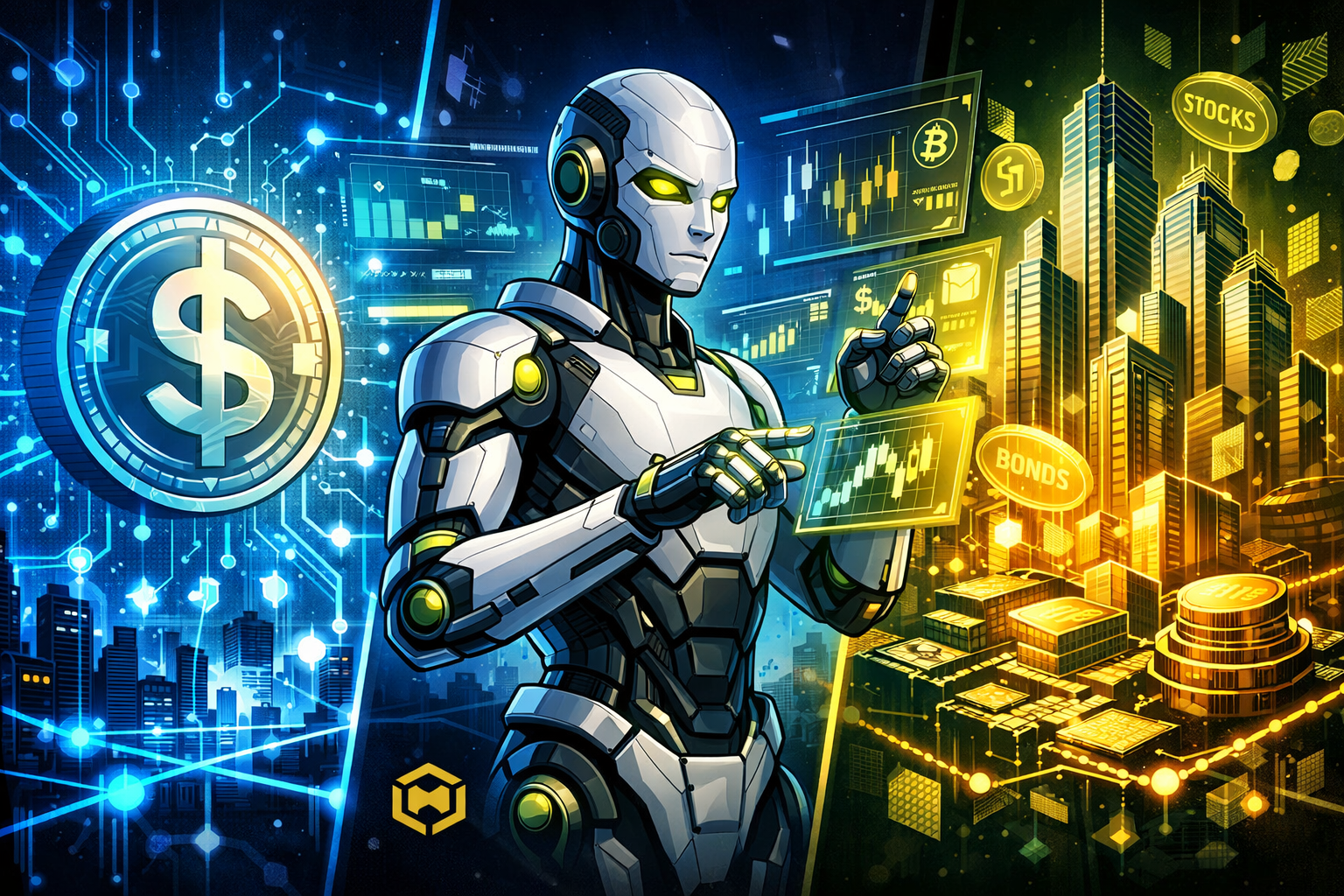
Why 2026 Could Be the Year Stablecoins, AI Agents, and Tokenization Finally Converge
Stablecoins, tokenized assets, and AI agents are rapidly reshaping crypto in 2026. Here’s why this convergence could define the industry’s next major growth phase.
By Val Andrew | chainintellectcoin.com | 2026-03-31
The next big crypto narrative may not come from speculation alone. In 2026, three powerful forces are moving toward each other at the same time: stablecoin infrastructure, tokenized real-world assets, and AI agents that need instant, programmable money. What looked like separate trends now appears to be one accelerating shift.
For years, the crypto industry moved in cycles driven by separate narratives. One season belonged to DeFi. Another belonged to NFTs. Then came memecoins, institutional ETFs, and AI tokens. But 2026 is starting to look different. Instead of one isolated trend dominating the market, several infrastructure trends are beginning to reinforce each other at the same time.
Stablecoins are becoming more central to digital asset policy and market structure. Tokenization is drawing growing interest from major financial players who see blockchain as a more efficient settlement rail. At the same time, AI agents are emerging as active participants in digital systems, creating demand for instant, machine-native payments and verifiable on-chain execution.
That combination matters because it reframes crypto from a speculative asset class into a functional digital economy. Stablecoins can provide the payment layer. Tokenization can bring real-world financial assets onto blockchain rails. AI agents can become the always-on users of those systems, paying, settling, analyzing, and executing in real time. Grayscale recently highlighted AI and tokenization as standout crypto sectors in Q1 2026, while IBM described tokenization as moving closer to an “all at once” moment in financial markets.
Policy is also becoming part of the story. Reuters reported on March 31, 2026 that the U.S. is moving toward clearer digital-asset market structure through the Digital Asset Market Clarity Act, while stablecoin legislation from 2025 continues shaping how dollar-backed digital assets may be supervised. Greater regulatory clarity does not guarantee adoption, but it lowers uncertainty around the rails that institutions and builders may rely on.
Meanwhile, firms building crypto intelligence and infrastructure are already leaning into AI agents. Chainalysis announced AI-agent capabilities for blockchain investigation workflows, and other crypto infrastructure players are increasingly framing blockchain rails as natural payment layers for agentic systems. That shift suggests the “AI plus crypto” thesis is moving from theory into product design.
The tokenization side is gaining momentum too. BlackRock CEO Larry Fink recently pointed to tokenization as a path toward making investing as simple as digital payments, and market coverage continues to frame tokenization platforms as key infrastructure bets rather than niche experiments.
For investors and builders, the biggest implication is this: the next phase of crypto may be less about chasing isolated trends and more about owning infrastructure tied to real utility. If stablecoins become the default internet settlement asset, if tokenized markets become easier to access, and if AI agents become autonomous economic actors, then the value in crypto could increasingly concentrate around networks and assets that sit at the center of that flow. That is the kind of structural shift the market tends to underprice in its early stages. This last point is an inference based on the direction of policy, infrastructure launches, and institutional commentary, not a confirmed market outcome.
Crypto in 2026 is still volatile, fragmented, and full of execution risk. But the more important signal may be that its most serious growth drivers are starting to connect. Stablecoins, tokenization, and AI agents are no longer separate headlines. They are becoming one story.
Opinion:
The strongest crypto narrative in 2026 is shifting from hype to infrastructure.
Prediction:
Projects tied to payment rails, tokenized asset settlement, and AI-agent transaction layers could gain more long-term attention than purely speculative themes.
Insight:
When separate trends begin sharing the same underlying rails, the market often starts rewarding infrastructure before the broader public notices.