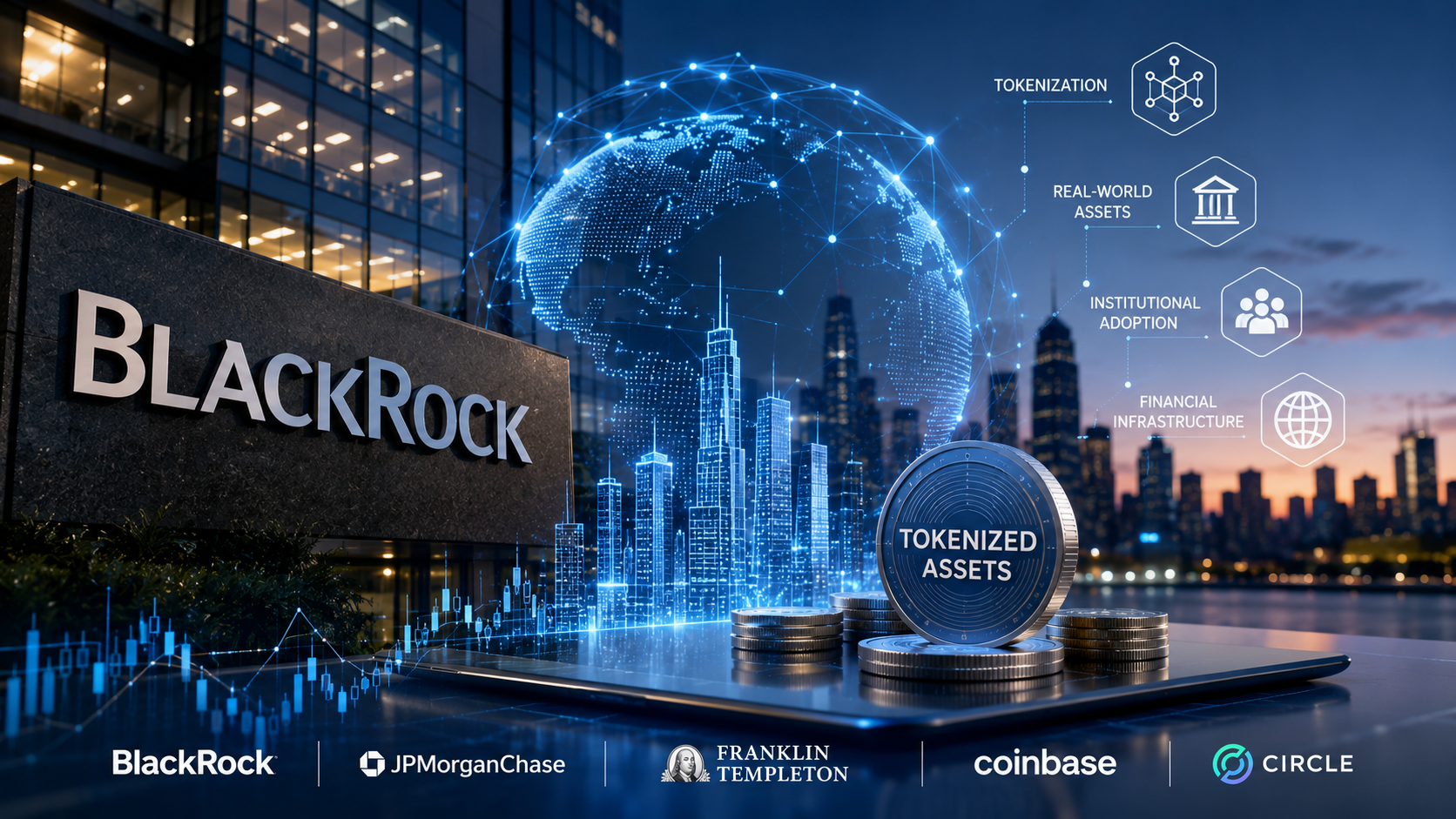
Why BlackRock's Tokenization Strategy May Signal a Bigger Shift in Global Finance
BlackRock, JPMorgan, Franklin Templeton, Coinbase, and Circle are exploring tokenized financial infrastructure. This analysis examines why tokenization may become one of the most important developments in modern capital markets.
By Val Andrew | chainintellectcoin.com | June 13, 2026
Val Andrew covers financial infrastructure, digital assets, capital markets, and economic transformation.
The Most Important Blockchain Story May Not Be Cryptocurrency
For years, blockchain discussions have focused on:
- Bitcoin
- cryptocurrency trading
- exchange activity
- market cycles
- speculative assets
Yet some of the most significant developments are occurring elsewhere.
Increasingly, major financial institutions are exploring tokenized financial assets.
One of the most closely watched examples involves asset-management giant BlackRock.
This raises an important question:
Why are some of the world's largest financial institutions paying increasing attention to tokenization?
The answer may reveal a broader transformation occurring across capital markets.
What Is Tokenization?
Tokenization refers to representing ownership rights digitally on blockchain-based infrastructure.
Examples under exploration across the financial industry include:
- money-market funds
- government securities
- private credit
- real estate interests
- alternative investments
The objective is not necessarily to create new assets.
The objective is often to improve how existing assets move, settle, and interact within financial systems.
The discussion increasingly focuses on infrastructure rather than speculation.
The Historical Pattern
Financial markets have repeatedly evolved through infrastructure improvements.
Examples include:
- electronic trading systems
- online brokerage platforms
- digital settlement networks
- real-time market data systems
Many of the most important financial innovations occurred behind the scenes.
Consumers rarely think about settlement architecture.
Institutions do.
Tokenization may represent another stage in that long-term evolution.
Why BlackRock Matters
BlackRock is one of the largest asset managers in the world.
When institutions of that scale evaluate emerging technologies, market participants pay attention.
The significance is not necessarily a single product or initiative.
The significance is what institutional interest may signal about future market infrastructure.
Large asset managers increasingly explore how blockchain-based systems could improve:
- operational efficiency
- settlement processes
- asset distribution
- liquidity management
- investor access
The conversation extends well beyond cryptocurrency markets.
Real-World Context
Tokenization is attracting attention from a growing range of financial organizations.
Examples include:
- BlackRock exploring tokenized financial products
- Franklin Templeton expanding blockchain-based fund initiatives
- JPMorgan Chase developing digital settlement infrastructure
- Coinbase supporting institutional digital-asset services
- Circle building stablecoin infrastructure connected to digital finance
The result is increasing interaction between traditional finance and blockchain-based systems.
The Infrastructure Opportunity
Many financial processes remain complex.
Transactions often involve:
- multiple intermediaries
- reconciliation procedures
- settlement delays
- operational costs
Tokenization may help streamline some of these functions.
The potential value is not simply digitization.
It is the possibility of more efficient financial coordination.
This is one reason institutions increasingly view tokenization as infrastructure rather than a niche technology trend.
The Contrarian View
Many investors continue viewing blockchain primarily through the lens of cryptocurrencies.
The larger institutional story may involve financial plumbing.
Historically, infrastructure changes often create long-term impact without generating immediate public attention.
Markets tend to focus on products.
Institutions often focus on systems.
Tokenization increasingly appears to be a systems story.
The Stablecoin Connection
Tokenization and stablecoins are becoming increasingly connected.
Tokenized assets require mechanisms for:
- settlement
- transfers
- liquidity
- transactions
Stablecoins may provide part of that infrastructure.
As tokenized ecosystems expand, digital dollars and blockchain-based settlement systems could become increasingly important components of financial operations.
The trends increasingly reinforce one another.
The Regulatory Question
Regulation remains a key factor.
Governments and regulators continue evaluating:
- market structure
- investor protection
- custody frameworks
- operational standards
- systemic considerations
The future pace of adoption may depend significantly on how regulatory frameworks evolve.
Infrastructure innovation and regulatory development often progress together.
The Global Competition
Financial centers increasingly compete to attract:
- capital
- innovation
- investment activity
- financial infrastructure
The ability to support modern digital financial systems may become an important competitive advantage.
Future leadership in capital markets may depend not only on scale, but also on infrastructure modernization.
The Deeper Insight
The most important financial revolutions are often infrastructure revolutions.
Electronic trading transformed markets.
Online brokerage expanded access.
Digital payments changed commerce.
Tokenization may represent the next stage of that progression.
The long-term significance of tokenization may not be measured by headlines or market cycles. It may be measured by whether it helps make capital markets more efficient, accessible, and programmable.
What appears today as a technology discussion may ultimately become an infrastructure discussion.
Where ChainIntellect Coin Fits Into the Broader Shift
Projects such as ChainIntellect Coin reflect the broader movement toward intelligent digital infrastructure, where blockchain systems, interoperability, automation, and data coordination increasingly support modern financial environments.
As tokenization, stablecoins, and digital financial networks continue evolving, intelligent ecosystems may play a growing role in connecting future capital markets.