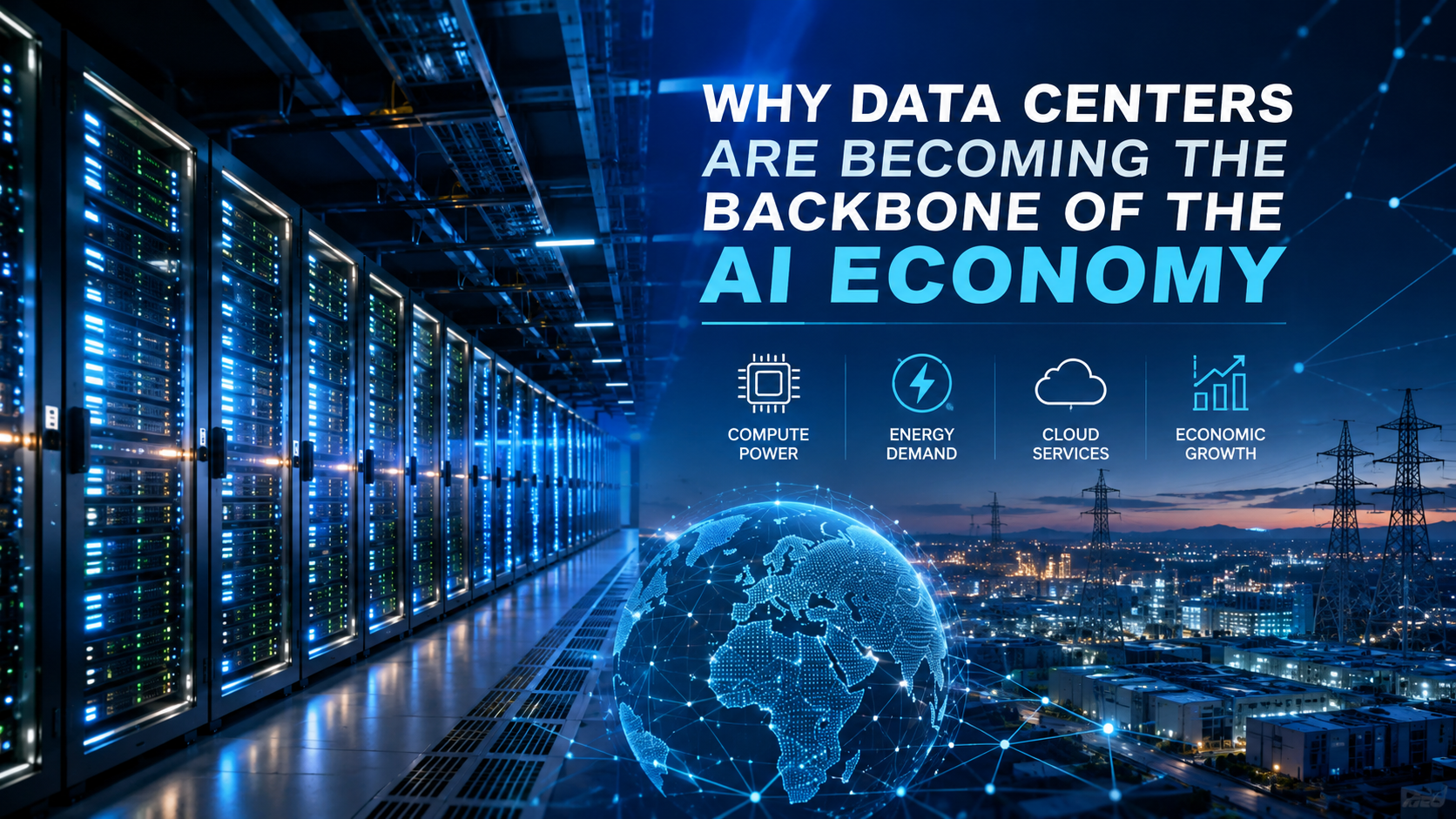
Why data centers are becoming the backbone of the AI economy
As AI adoption accelerates, data centers are becoming critical infrastructure powering computing, energy demand, cloud services, and economic growth.
By Val Andrew | ChainIntellect Coin |
Published June 1, 2026 • 10:00 AM UTC.
Technology, Artificial Intelligence and Infrastructure.
Artificial intelligence is often discussed in terms of software breakthroughs, advanced models, and rapidly expanding capabilities. Yet behind every AI-generated response, image, recommendation, and prediction lies a critical layer of infrastructure that receives far less attention: data centers.
As governments, technology companies, and investors race to expand AI capabilities, data centers are emerging as one of the most important strategic assets of the digital economy. Industry analysts increasingly view computing infrastructure, energy availability, and network capacity as key factors that could determine which regions and organizations lead the next phase of AI development.
According to research from the International Energy Agency and other industry observers, electricity demand from data centers is expected to increase as artificial intelligence adoption expands across sectors including healthcare, finance, manufacturing, logistics, education, and scientific research.
The shift highlights a broader reality. The future of artificial intelligence may depend not only on better algorithms but also on the infrastructure required to operate them at scale.
Key Takeaways
- Data centers are becoming foundational infrastructure for AI growth.
- Computing demand is increasing as AI adoption expands globally.
- Energy availability is emerging as a major constraint on future AI development.
- Governments are treating digital infrastructure as a strategic priority.
- Investors are increasingly evaluating AI through an infrastructure lens.
Why data centers matter more than ever
Every AI application relies on physical computing resources. Behind the scenes, data centers provide the processing power, storage capacity, networking systems, and cooling technologies required to train and operate advanced AI systems.
Large-scale AI models require substantial computational resources during both training and deployment. As organizations integrate AI into everyday operations, demand for infrastructure continues to grow.
This trend is changing how industry leaders think about long-term competitiveness. Access to computing capacity may become as important as access to talent, capital, and intellectual property.
The growing energy challenge
One of the most significant consequences of AI expansion is rising electricity demand.
Industry research from organizations including the International Energy Agency and Deloitte suggests that power infrastructure may become one of the most important factors influencing future data center development.
To meet future demand, operators are exploring:
- Renewable energy projects.
- Advanced cooling systems.
- More efficient hardware.
- Grid modernization initiatives.
- Emerging energy technologies.
In many regions, energy availability is becoming a central part of the AI conversation.
A global infrastructure race
Countries around the world are investing heavily in digital infrastructure.
Research from the Brookings Institution highlights how data centers increasingly influence economic competitiveness, technological leadership, innovation capacity, and national resilience.
Major investments are underway across North America, Europe, Asia, and the Middle East as governments seek to strengthen their positions in the global AI ecosystem.
For policymakers, the challenge is no longer limited to supporting software innovation. It increasingly involves ensuring access to the infrastructure required to support future growth.
Why it matters
Artificial intelligence is often described as the defining technology of the next decade. However, AI systems cannot operate without the physical infrastructure that supports them.
Data centers are becoming the factories of the digital age—providing the computing power that enables modern AI applications to function.
As demand for artificial intelligence continues to expand, investment in infrastructure may become one of the most important economic and technological themes of the decade.
The organizations, regions, and countries that successfully build scalable, reliable, and efficient digital infrastructure may be best positioned to benefit from the next generation of AI innovation.
Discussion
Will energy availability become the biggest bottleneck for AI growth, or will advances in computing efficiency offset rising demand?
The answer could shape the future of artificial intelligence, infrastructure investment, and economic development worldwide.
Sources and Further Reading
- International Energy Agency (IEA)
- Brookings Institution
- Deloitte Insights
- World Economic Forum
- Public research on AI infrastructure and energy demand
About the Author
Val Andrew is an independent technology researcher and writer covering artificial intelligence, digital infrastructure, blockchain systems, and emerging technology trends. His work focuses on the intersection of technology, economics, and long-term infrastructure development.
Editorial Note
This article is part of ChainIntellect Coin News' technology coverage and is intended for informational and educational purposes. It does not constitute financial, investment, legal, or professional advice.