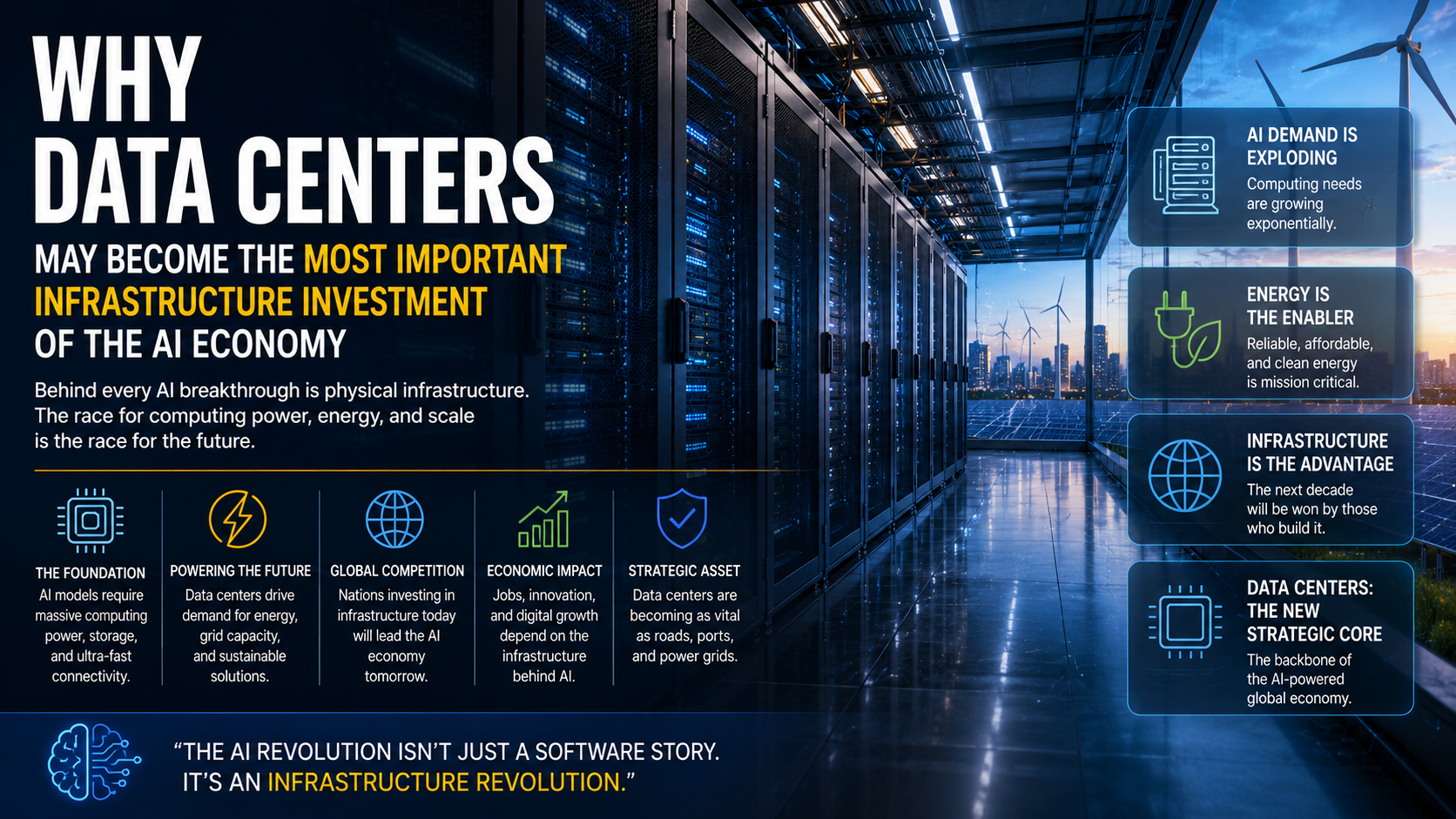
Why Data Centers May Become the Most Important Infrastructure Investment of the AI Economy
As AI adoption accelerates, data centers are becoming critical infrastructure for the digital economy. This analysis explores why computing capacity, energy, and infrastructure may shape the next phase of AI growth.
By Val Andrew | chainintellectcoin.com | June 1, 2026
Val Andrew covers artificial intelligence, digital infrastructure, and financial technology.
The AI Boom Is Creating an Unexpected Infrastructure Race
Most discussions about artificial intelligence focus on:
- AI models
- chatbots
- software platforms
- productivity tools
Yet behind every AI system is a less visible foundation.
Data centers.
As AI adoption accelerates across industries, demand for computing infrastructure is expanding at a pace that few predicted just a few years ago.
This raises a critical question:
Could data centers become the most important infrastructure investment of the AI era?
The answer may have implications far beyond the technology sector.
AI Runs on Physical Infrastructure
Artificial intelligence often feels intangible.
Users interact with software interfaces, not physical assets.
However, every AI query requires:
- computing power
- networking capacity
- energy consumption
- storage infrastructure
- cooling systems
Large-scale AI systems depend on massive physical infrastructure investments.
Without data centers, there is no AI economy.
The Infrastructure Bottleneck
As AI demand grows, infrastructure constraints are becoming increasingly visible.
Major technology companies are investing billions of dollars into expanding computing capacity.
Challenges include:
- electricity availability
- semiconductor supply
- cooling requirements
- land availability
- network connectivity
In many regions, infrastructure expansion is becoming one of the largest limiting factors for AI deployment.
The next stage of AI competition may depend less on software and more on infrastructure capacity.
Real-World Context
Companies including:
- Microsoft
- Amazon
- Meta
- NVIDIA
continue investing heavily in AI infrastructure, cloud computing, and data-center expansion.
Meanwhile, governments worldwide are increasingly evaluating energy policy, grid capacity, and digital infrastructure as strategic economic priorities.
The AI race is becoming as much an infrastructure race as a software race.
The Contrarian View
Many investors focus on AI applications.
The larger opportunity may lie beneath the applications themselves.
Historically, infrastructure providers often capture significant value during periods of technological transformation.
Examples include:
- railroads during industrial expansion
- telecommunications during internet adoption
- cloud computing during digital transformation
AI may follow a similar pattern.
The companies building the infrastructure that powers AI could become as important as the companies developing AI applications.
Energy Is Becoming Part of the Story
AI infrastructure consumes enormous amounts of electricity.
As data-center demand expands:
- power generation becomes increasingly important
- grid modernization becomes more urgent
- energy security becomes more strategic
This creates a new relationship between technology policy and energy policy.
Future AI competitiveness may depend not only on computing power, but also on access to reliable energy infrastructure.
The Global Competition
Countries are increasingly treating AI infrastructure as a strategic national priority.
Governments are investing in:
- semiconductor production
- cloud infrastructure
- energy systems
- high-speed connectivity
- research facilities
This creates a new form of economic competition.
The nations capable of supporting large-scale AI infrastructure may gain advantages in innovation, productivity, and digital economic growth.
The Risk
Infrastructure expansion introduces challenges.
These include:
- environmental concerns
- energy consumption
- capital intensity
- supply-chain dependence
- geographic concentration
The same infrastructure that enables AI growth can also create new vulnerabilities if capacity becomes concentrated in a small number of regions or providers.
The Deeper Insight
The AI revolution is often discussed as a software story.
It may ultimately become an infrastructure story.
Throughout history, transformative technologies have relied on physical systems that most consumers rarely see.
Railroads enabled industrial growth.
Electrical grids enabled modern economies.
Telecommunications networks enabled the internet.
AI may depend on data centers in much the same way.
The most important assets of the AI economy may not be algorithms alone. They may be the infrastructure systems capable of powering them at global scale.
Where ChainIntellect Coin Fits Into the Broader Shift
Projects such as ChainIntellect Coin reflect the broader movement toward intelligent digital infrastructure, where automation, interoperability, data coordination, and decentralized systems increasingly support next-generation economic activity.
As AI infrastructure expands, intelligent blockchain ecosystems may play a growing role in connecting digital systems, data networks, and automated financial environments.