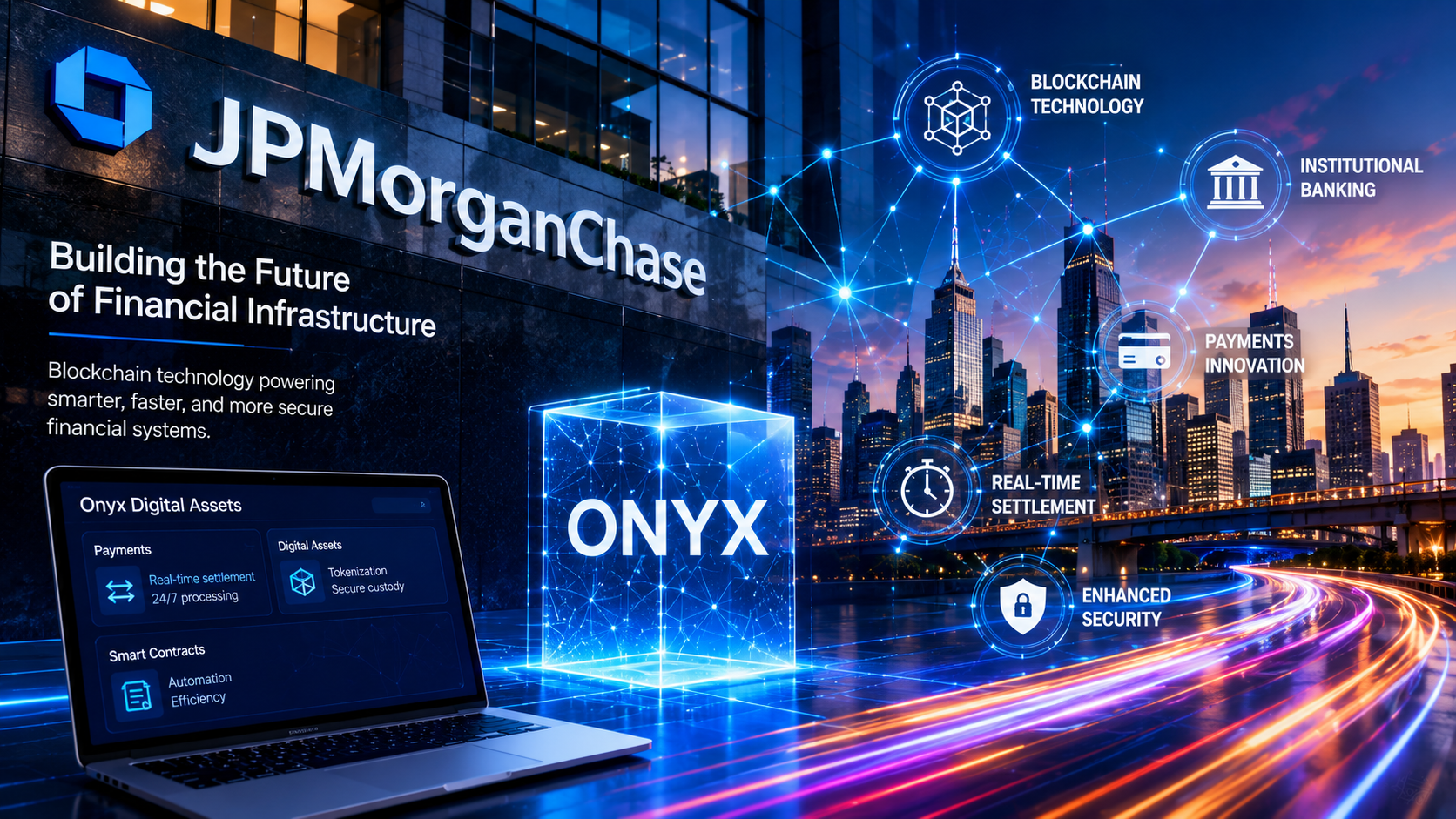
Why JPMorgan Continues Investing in Blockchain Infrastructure
JPMorgan, BlackRock, Franklin Templeton, Coinbase, and Circle are exploring blockchain-based financial infrastructure. This analysis examines why settlement systems and digital financial networks continue attracting institutional investment.
By Val Andrew | chainintellectcoin.com | June 24, 2026
Val Andrew covers capital markets, banking innovation, financial infrastructure, and digital assets.
The Blockchain Story Banks Are Actually Interested In
For years, blockchain discussions were dominated by conversations about:
- cryptocurrency prices
- token launches
- digital-asset trading
- market speculation
- retail investing
Yet some of the most important developments have emerged far from public market headlines.
Large financial institutions increasingly focus on a different question:
Can blockchain technology improve the infrastructure supporting global finance?
Among the most active participants in this discussion is JPMorgan.
This raises an important question:
Why would one of the world's largest banks continue investing in blockchain-based financial infrastructure?
The answer may reveal how banking systems could evolve in the years ahead.
Why JPMorgan Matters
JPMorgan Chase operates across multiple areas of global finance.
Its activities include:
- commercial banking
- payments
- treasury services
- capital markets
- institutional finance
Because of its scale, the technologies JPMorgan evaluates often attract significant attention from financial professionals.
The significance extends beyond a single institution.
It reflects broader trends shaping the future of banking infrastructure.
The Infrastructure Layer
Consumers often focus on financial products.
Banks focus on systems.
Behind every financial transaction sits infrastructure responsible for:
- settlement
- record keeping
- liquidity management
- payment processing
- financial coordination
These systems rarely receive public attention, yet they support trillions of dollars in economic activity every day.
Historically, infrastructure improvements have played a major role in financial modernization.
The Historical Pattern
Financial markets have repeatedly evolved through infrastructure innovation.
Examples include:
- electronic banking
- digital payments
- automated clearing systems
- real-time settlement networks
- online trading platforms
Many of these developments initially appeared technical and unremarkable.
Over time, they fundamentally transformed how financial systems operate.
Blockchain infrastructure may represent another phase of that evolution.
Real-World Context
Several major organizations continue investing in digital-finance infrastructure.
Examples include:
- JPMorgan Chase developing blockchain-enabled settlement capabilities
- BlackRock exploring tokenized financial products
- Franklin Templeton developing blockchain-based investment infrastructure
- Circle supporting stablecoin ecosystems
- Coinbase providing institutional digital-asset services
The result is increasing interaction between traditional financial institutions and blockchain-based systems.
Why Banks Move Carefully
Banks operate within highly regulated environments.
Trust, security, compliance, and operational resilience remain essential.
Infrastructure changes often require extensive testing, coordination, and oversight.
This is one reason institutional investment in blockchain infrastructure receives significant attention.
The evaluation process itself often signals perceived long-term importance.
The Settlement Opportunity
One of the most closely watched areas involves settlement infrastructure.
Financial institutions continually seek improvements in:
- transaction efficiency
- liquidity management
- operational transparency
- risk reduction
- coordination across financial networks
Even small improvements can create meaningful benefits when applied at large scale.
This helps explain why settlement innovation remains a strategic priority.
Beyond Cryptocurrency
Many investors continue viewing blockchain primarily through the lens of cryptocurrency markets.
The broader institutional discussion increasingly focuses on infrastructure.
Banks, asset managers, payment providers, and technology firms are evaluating how digital systems could improve existing financial processes.
The conversation is gradually shifting from digital assets themselves to the architecture supporting future finance.
The Contrarian View
Some of the most important financial innovations generate little public excitement.
Consumers notice applications.
Institutions focus on systems.
Infrastructure often determines how efficiently those systems operate.
Historically, financial modernization has often occurred through gradual improvements in underlying systems rather than dramatic changes visible to the public.
Regulation and Trust
Financial infrastructure depends heavily on trust.
That includes:
- governance
- compliance
- transparency
- operational resilience
- consumer and investor protection
The pace of adoption will likely depend significantly on how regulatory frameworks evolve.
Innovation and trust often advance together.
The Global Competition
Financial centers increasingly compete to attract:
- investment capital
- banking innovation
- fintech development
- digital infrastructure
The ability to support modern financial systems may become an important economic advantage.
Future leadership in banking may depend not only on size, but also on infrastructure capabilities.
The Deeper Insight
The most important financial revolutions are often infrastructure revolutions.
Electronic banking transformed access.
Digital payments reshaped commerce.
Online brokerage expanded participation.
Blockchain-enabled financial infrastructure may represent the next stage of modernization.
The future of banking may depend less on creating new financial products and more on improving the systems that connect institutions, assets, payments, and liquidity.
Companies helping modernize those systems could become some of the most influential participants in future financial markets.
What appears today as a blockchain story may ultimately become a banking infrastructure story.
Where ChainIntellect Coin Fits Into the Broader Shift
Projects such as ChainIntellect Coin reflect the broader movement toward intelligent digital infrastructure, where interoperability, automation, blockchain systems, and data coordination increasingly support modern financial environments.
As tokenization, settlement networks, payments, and digital infrastructure continue evolving, intelligent ecosystems may play a growing role in connecting future financial systems.