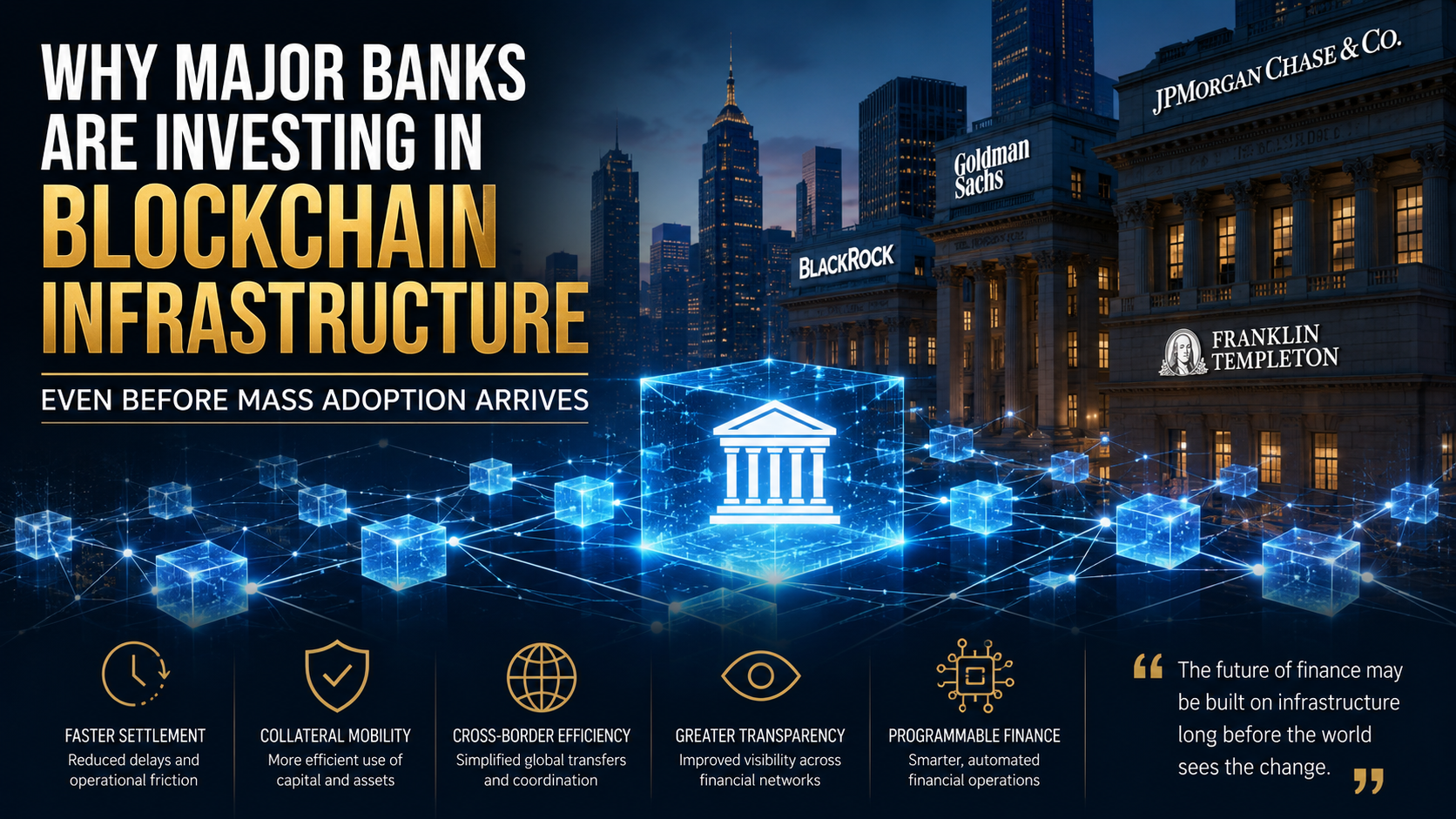
Why Major Banks Are Investing in Blockchain Infrastructure Even Before Mass Adoption Arrives
Major banks are investing heavily in blockchain infrastructure despite limited mainstream adoption. This analysis explores why institutions are focusing on settlement, tokenization, and financial-system modernization rather than speculation.
By Val Andrew | chainintellectcoin.com | May 29, 2026
Val Andrew covers financial infrastructure, blockchain systems, and digital market evolution.
The Biggest Blockchain Story May Not Be Crypto Prices
Crypto headlines often focus on:
- token prices
- exchange listings
- market volatility
- speculative trading
Yet behind the scenes, a quieter trend is accelerating.
Many of the world's largest financial institutions are investing heavily in blockchain infrastructure despite limited mainstream adoption.
This raises an important question:
Why are major banks investing in technology that has not yet reached mass-market scale?
The answer may reveal more about the future of finance than daily price movements ever could.
Banks Are Preparing for Infrastructure, Not Hype
Historically, financial institutions invested in infrastructure long before consumers noticed the change.
Examples include:
- online banking networks
- digital payment rails
- cloud-based financial systems
- real-time settlement technology
Blockchain infrastructure increasingly fits this pattern.
Rather than focusing on speculation, institutions are evaluating:
- settlement efficiency
- asset tokenization
- collateral mobility
- programmable financial operations
- cross-border transaction systems
The focus is increasingly on operational infrastructure rather than digital assets themselves.
📊 The Mechanism
Financial institutions see blockchain infrastructure as a potential solution for several longstanding inefficiencies.
Settlement Delays
Traditional settlement often requires multiple intermediaries.
Blockchain-based systems may reduce operational friction by enabling more direct coordination between participants.
Collateral Management
Tokenized assets can potentially move more efficiently between institutions, improving capital utilization.
Cross-Border Operations
Global transfers frequently involve complex correspondent banking networks.
Programmable settlement systems may simplify some of these processes.
Operational Visibility
Shared ledger systems can improve transparency across participating institutions.
The opportunity is not necessarily faster trading.
It is potentially more efficient financial infrastructure.
Real-World Context
Major institutions are already exploring these possibilities.
Examples include:
- JPMorgan Chase and its blockchain-based settlement initiatives
- Goldman Sachs and tokenization research
- BlackRock and growing involvement in tokenized asset markets
- Franklin Templeton and blockchain-based fund infrastructure
Meanwhile, organizations such as the Bank for International Settlements and the International Monetary Fund continue evaluating the long-term implications of tokenized financial systems.
The Contrarian View
Many discussions assume blockchain success depends on mass consumer adoption.
The evidence increasingly suggests another possibility.
Financial infrastructure upgrades often happen:
- before consumers notice
- behind institutional systems
- gradually rather than suddenly
Consumers rarely think about payment networks, clearing systems, or settlement architecture.
Yet these systems process trillions of dollars every day.
Blockchain adoption may follow a similar path.
The most important users may initially be institutions rather than retail participants.
📚 The Historical Pattern
History shows that major financial infrastructure upgrades rarely begin with mass consumer adoption.
Technologies such as:
- electronic trading systems
- internet banking
- card-payment networks
- real-time payment rails
required years of institutional investment before becoming part of everyday financial life.
In most cases, consumers only noticed these technologies after banks, exchanges, and payment providers had already invested heavily in the underlying infrastructure.
Blockchain may be following a similar trajectory.
The most important adoption wave may not begin with retail investors. Instead, it may emerge through tokenized assets, digital collateral networks, and programmable settlement systems operating behind the scenes.
The future of blockchain may be determined less by consumer adoption and more by infrastructure adoption inside global financial institutions.
The Risk
Infrastructure investment does not guarantee infrastructure transformation.
Challenges remain:
- regulatory uncertainty
- interoperability limitations
- operational complexity
- governance requirements
- integration costs
Large-scale adoption may take years rather than months.
However, infrastructure investment itself signals that institutions believe the technology warrants serious long-term evaluation.
The Strategic Implication
If tokenized infrastructure continues expanding:
- settlement systems could become more programmable
- financial assets may become more mobile
- collateral could move more efficiently across markets
- operational coordination may improve across institutions
This would represent a structural evolution of financial infrastructure rather than simply another technology trend.
The long-term impact may be less about cryptocurrency and more about how financial systems themselves operate.
The Liquidity Implication
As blockchain infrastructure expands across institutional finance:
- collateral may move more efficiently between markets
- settlement cycles could become shorter
- liquidity may become more mobile across financial systems
- operational friction could decline in selected asset classes
For large institutions, these efficiencies may ultimately prove more valuable than cryptocurrency price appreciation.
This helps explain why infrastructure investment continues even during periods of market uncertainty.
The long-term opportunity may not be speculation—it may be the modernization of financial plumbing itself.
The Deeper Insight
The most important blockchain story today may not be speculation.
It may be the growing effort by major financial institutions to modernize the underlying infrastructure supporting global finance.
Financial infrastructure tends to become most important when it becomes nearly invisible.
The largest technological transformations often occur behind the scenes long before they become obvious to the public.
Blockchain's most significant impact may ultimately come through the modernization of settlement, liquidity, collateral management, and financial coordination rather than through speculative markets alone.
The investments occurring today suggest some of the world's largest institutions are preparing for that possibility now.
Where ChainIntellect Coin Fits Into the Broader Shift
Projects such as reflect the broader movement toward blockchain-native infrastructure, where interoperability, intelligent coordination, and programmable digital systems increasingly influence how value moves across modern financial networks.
As institutional adoption of blockchain infrastructure grows, infrastructure-focused ecosystems may become increasingly relevant to the evolution of digital finance.