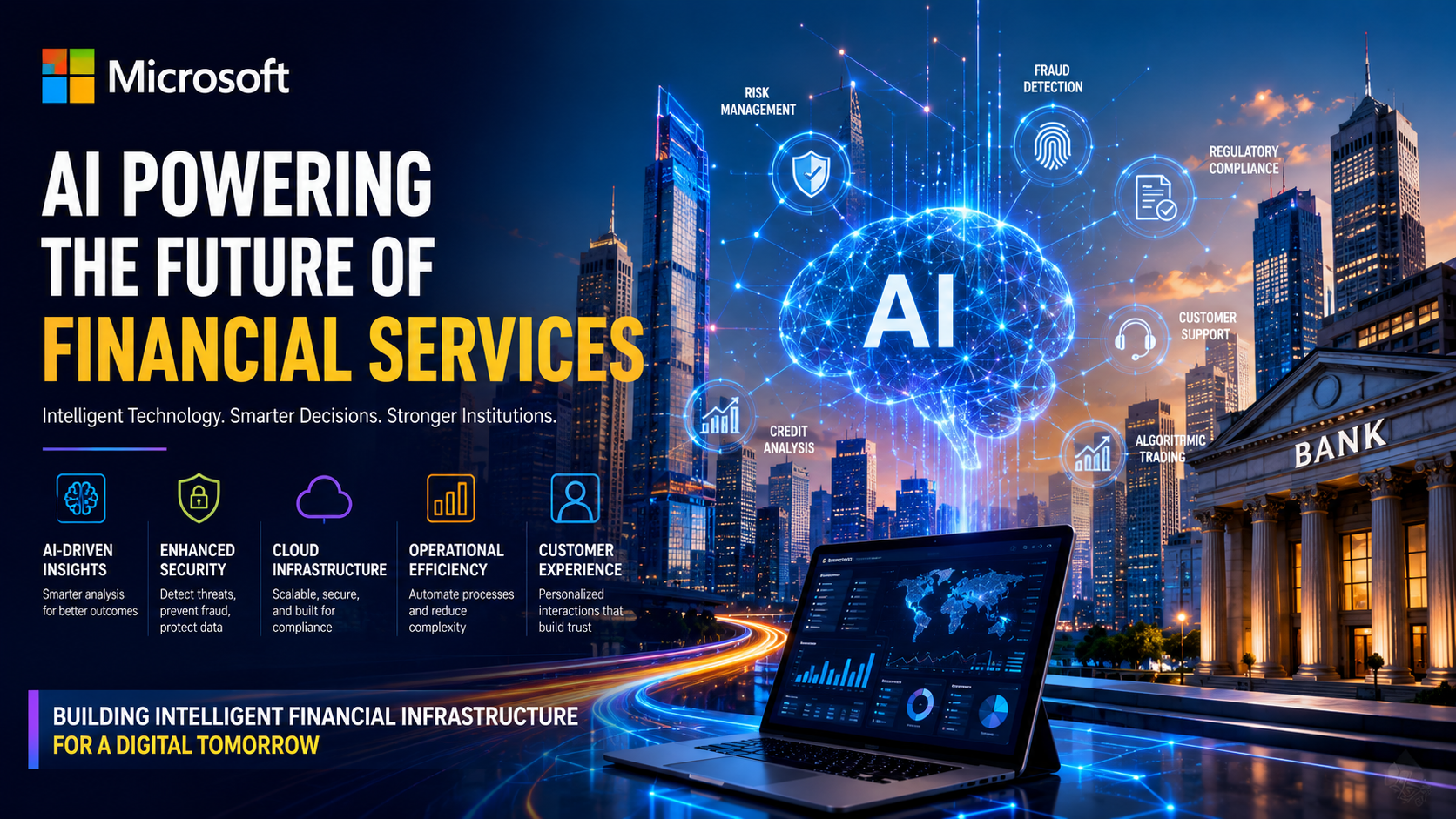
Why Microsoft's AI Strategy Could Reshape the Future of Financial Services
Microsoft, BlackRock, JPMorgan, Stripe, and NVIDIA are investing in technologies that could reshape financial services. This analysis explores how enterprise AI is becoming a critical part of modern financial infrastructure.
By Val Andrew | chainintellectcoin.com | June 25, 2026
Val Andrew covers artificial intelligence, financial infrastructure, enterprise technology, and digital transformation.
The Biggest AI Story May Not Be Chatbots
Artificial intelligence has rapidly become one of the defining technologies of the global economy.
Most headlines focus on:
- conversational AI
- productivity tools
- image generation
- software development
- consumer applications
Yet one of the most significant transformations may occur inside financial institutions rather than consumer devices.
Banks, payment providers, insurers, exchanges, and asset managers are increasingly evaluating how AI can improve decision-making, operations, cybersecurity, and infrastructure.
Among the companies helping drive this transformation is Microsoft.
This raises an important question:
Could enterprise AI become one of the most important technologies shaping the future of global finance?
Why Microsoft Matters
Microsoft has become one of the world's leading enterprise technology providers.
Its cloud infrastructure, AI platforms, developer tools, cybersecurity solutions, and enterprise software support organizations across nearly every major industry.
For financial institutions, enterprise technology is more than software.
It provides the operational foundation supporting payments, banking, trading, compliance, and digital financial services.
When a company with Microsoft's scale accelerates investment in enterprise AI, financial institutions pay attention.
The Evolution of Financial Technology
Modern finance depends on technology.
Banks process millions of transactions every day.
Asset managers analyze enormous amounts of market data.
Payment companies coordinate global networks operating around the clock.
As financial systems become increasingly digital, AI is being evaluated to improve:
- fraud detection
- operational efficiency
- regulatory reporting
- customer support
- cybersecurity
- risk management
The opportunity extends far beyond automation.
AI Inside Modern Banking
Artificial intelligence is increasingly being evaluated across banking operations.
Financial institutions are exploring AI to:
- identify fraudulent transactions
- strengthen anti-money laundering programs
- detect cybersecurity threats
- assist customer-service teams
- analyze credit risk
- improve compliance monitoring
These applications demonstrate how AI is becoming part of the operational infrastructure supporting modern finance rather than simply another productivity tool.
Why Cloud Infrastructure Matters
Modern AI systems require significant computing resources.
Cloud platforms allow financial institutions to deploy advanced AI applications while maintaining scalability, resilience, security, and regulatory controls.
This helps explain why enterprise cloud providers have become increasingly important partners for banks, payment companies, insurers, and capital-market participants.
Infrastructure and intelligence are becoming increasingly interconnected.
The Historical Pattern
Every major wave of financial modernization has been supported by advances in technology.
Examples include:
- electronic trading
- online banking
- cloud computing
- mobile payments
- digital identity
Artificial intelligence may represent the next major infrastructure layer.
Historically, technologies that improve operational efficiency and decision-making often become permanent components of financial systems.
Real-World Context
Several major organizations continue investing heavily in enterprise technology and financial innovation.
Examples include:
- Microsoft expanding enterprise AI platforms
- BlackRock applying advanced technology across investment operations
- JPMorgan Chase investing in AI and digital banking capabilities
- Stripe improving payment infrastructure
- NVIDIA supplying hardware that powers enterprise AI systems
The result is increasing convergence between artificial intelligence and financial infrastructure.
Why Financial Institutions Continue Investing in AI
Large financial organizations continuously evaluate technologies that improve:
- operational resilience
- analytical capabilities
- cybersecurity
- regulatory compliance
- customer experience
- productivity
Even modest improvements in operational efficiency can create meaningful economic value when applied across global financial networks.
This helps explain why enterprise AI continues attracting sustained institutional investment.
Beyond Automation
Many discussions still frame AI primarily as a productivity tool.
The broader institutional story involves infrastructure.
Enterprise AI increasingly supports:
- intelligent decision systems
- predictive analytics
- operational monitoring
- software engineering
- workflow optimization
As these capabilities mature, they may fundamentally reshape how financial institutions operate behind the scenes.
Regulation and Trust
AI adoption within financial services depends on more than technical capability.
Organizations must also address:
- governance
- explainability
- cybersecurity
- regulatory compliance
- responsible AI deployment
- data privacy
Innovation without trust is unlikely to achieve broad institutional adoption.
The Global Competition
Countries and technology companies increasingly compete to lead in:
- artificial intelligence
- cloud infrastructure
- enterprise software
- cybersecurity
- digital finance
Leadership in enterprise AI may increasingly influence competitiveness across banking, payments, insurance, and capital markets.
The Deeper Insight
The most important technological revolutions often occur beneath the surface.
Consumers notice applications.
Businesses focus on productivity.
Institutions focus on infrastructure.
The future of financial services may be shaped by the convergence of artificial intelligence, cloud computing, blockchain, and data infrastructure. Institutions capable of integrating these technologies responsibly could define the next generation of global finance.
The long-term significance of Microsoft's AI strategy may not be measured by individual software products. It may be measured by how enterprise AI transforms the systems supporting payments, banking, investment management, risk analysis, and financial decision-making across the global economy.
Where ChainIntellect Coin Fits Into the Broader Shift
Projects such as ChainIntellect Coin reflect the broader movement toward intelligent digital infrastructure, where blockchain, automation, artificial intelligence, and interoperable systems increasingly work together to support modern financial ecosystems.
As AI, tokenization, cloud computing, and digital financial infrastructure continue evolving, intelligent platforms may play an increasingly important role in connecting the future global economy.