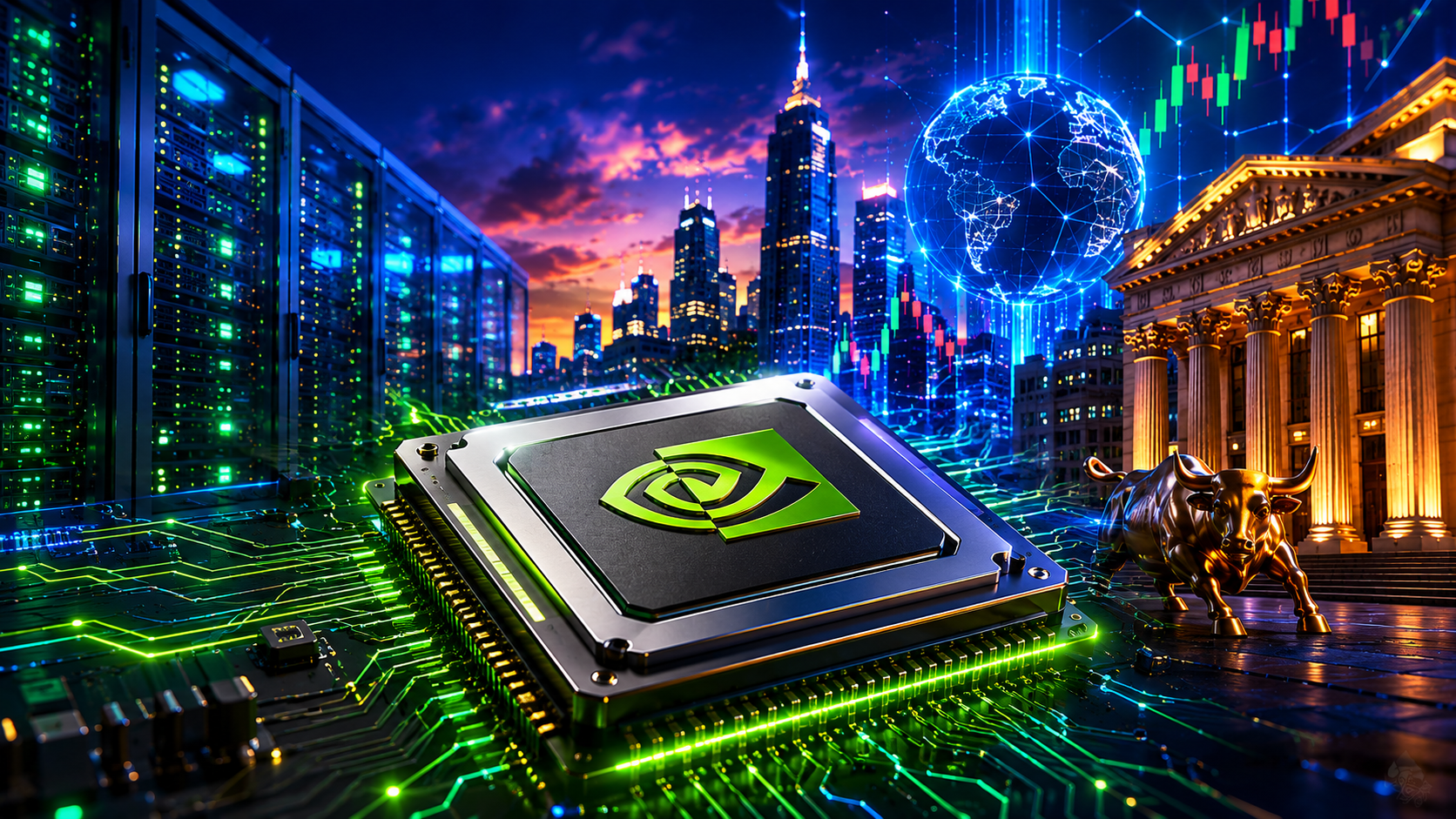
Why NVIDIA Is Becoming Critical Infrastructure for the Future of Finance
NVIDIA, Microsoft, JPMorgan, BlackRock, and Stripe are investing in technologies reshaping financial infrastructure. This analysis explores why AI computing is becoming a critical foundation for the future of financial services.
By Val Andrew | chainintellectcoin.com | June 26, 2026
Val Andrew covers artificial intelligence, enterprise computing, financial infrastructure, and digital transformation.
The AI Revolution Depends on More Than Software
Artificial intelligence has become one of the defining technologies of the decade.
Much of the public discussion focuses on:
- AI chatbots
- software applications
- automation
- content generation
- productivity tools
Yet behind every advanced AI system is another layer that receives far less attention.
Computing infrastructure.
As banks, payment providers, insurers, and asset managers expand their use of artificial intelligence, demand for high-performance computing continues to grow.
Among the companies at the center of this transformation is NVIDIA.
This raises an important question:
Why has an AI hardware company become increasingly important to the future of financial services?
Why NVIDIA Matters
NVIDIA develops computing platforms that power many of today's advanced artificial intelligence workloads.
Its technologies support organizations working in:
- healthcare
- manufacturing
- scientific research
- autonomous systems
- financial services
As AI adoption expands, computing infrastructure becomes a strategic resource rather than simply another technology purchase.
AI Requires Infrastructure
Enterprise AI depends on several foundational components working together.
These include:
- high-performance computing
- cloud infrastructure
- cybersecurity
- enterprise software
- high-quality data
Without these building blocks, even the most advanced AI models cannot operate efficiently.
This helps explain why infrastructure providers have become increasingly important to financial institutions.
The Evolution of Financial Computing
Financial markets have always depended on technological innovation.
Previous waves included:
- electronic trading
- online banking
- digital payments
- cloud computing
- real-time analytics
Artificial intelligence represents the next stage of this evolution.
However, unlike previous technology cycles, AI requires significant computational capacity to train, deploy, and operate sophisticated models.
Real-World Context
Several global organizations continue investing in enterprise AI and financial modernization.
Examples include:
- NVIDIA supplying AI computing platforms
- Microsoft expanding enterprise AI and cloud services
- JPMorgan Chase investing in AI-powered banking capabilities
- BlackRock applying advanced technology across investment operations
- Stripe improving digital payment infrastructure
The result is increasing convergence between enterprise computing and financial services.
Why Financial Institutions Need More Computing Power
Banks and financial organizations increasingly analyze:
- transaction activity
- fraud indicators
- cybersecurity threats
- market information
- customer interactions
Artificial intelligence enables institutions to process these large volumes of information more efficiently.
As data volumes continue growing, computing infrastructure becomes increasingly important.
Beyond Artificial Intelligence
Although AI attracts much of the attention, the larger story involves digital infrastructure.
Enterprise computing increasingly supports:
- cybersecurity
- regulatory compliance
- cloud operations
- financial modeling
- risk analysis
Infrastructure investments often create long-term competitive advantages because they improve multiple areas of business simultaneously.
Why Infrastructure Creates Competitive Advantage
Historically, organizations investing early in transformative infrastructure often improve:
- operational efficiency
- analytical capabilities
- resilience
- scalability
- innovation capacity
This pattern has appeared throughout previous technology transitions, including cloud computing and internet infrastructure.
AI computing may represent another major infrastructure cycle.
Regulation and Trust
Financial institutions adopting advanced AI systems must also address:
- governance
- cybersecurity
- transparency
- regulatory compliance
- responsible AI deployment
Technology alone is insufficient.
Successful adoption depends on combining innovation with trusted operational frameworks.
The Global Competition
Countries and technology companies increasingly compete to lead in:
- artificial intelligence
- semiconductor innovation
- cloud computing
- enterprise software
- digital financial infrastructure
Leadership in computing infrastructure may increasingly influence competitiveness across banking, payments, investment management, and financial technology.
The Deeper Insight
Every major technological transformation has depended on infrastructure.
Railways supported industrial expansion.
Telecommunications accelerated global commerce.
Cloud computing transformed enterprise software.
Artificial intelligence may become the next foundational technology—but only if supported by sufficient computing power.
The future of financial services may depend not only on better algorithms, but also on the infrastructure capable of processing vast amounts of information securely, efficiently, and at global scale.
Organizations building that foundation could become some of the most influential technology providers of the next decade.
Where ChainIntellect Coin Fits Into the Broader Shift
Projects such as ChainIntellect Coin reflect the broader movement toward intelligent digital infrastructure, where blockchain, artificial intelligence, cloud computing, and automation increasingly work together to support secure, scalable, and interoperable financial ecosystems.
As enterprise AI, tokenization, and digital finance continue evolving, intelligent platforms may help connect the next generation of global financial infrastructure.