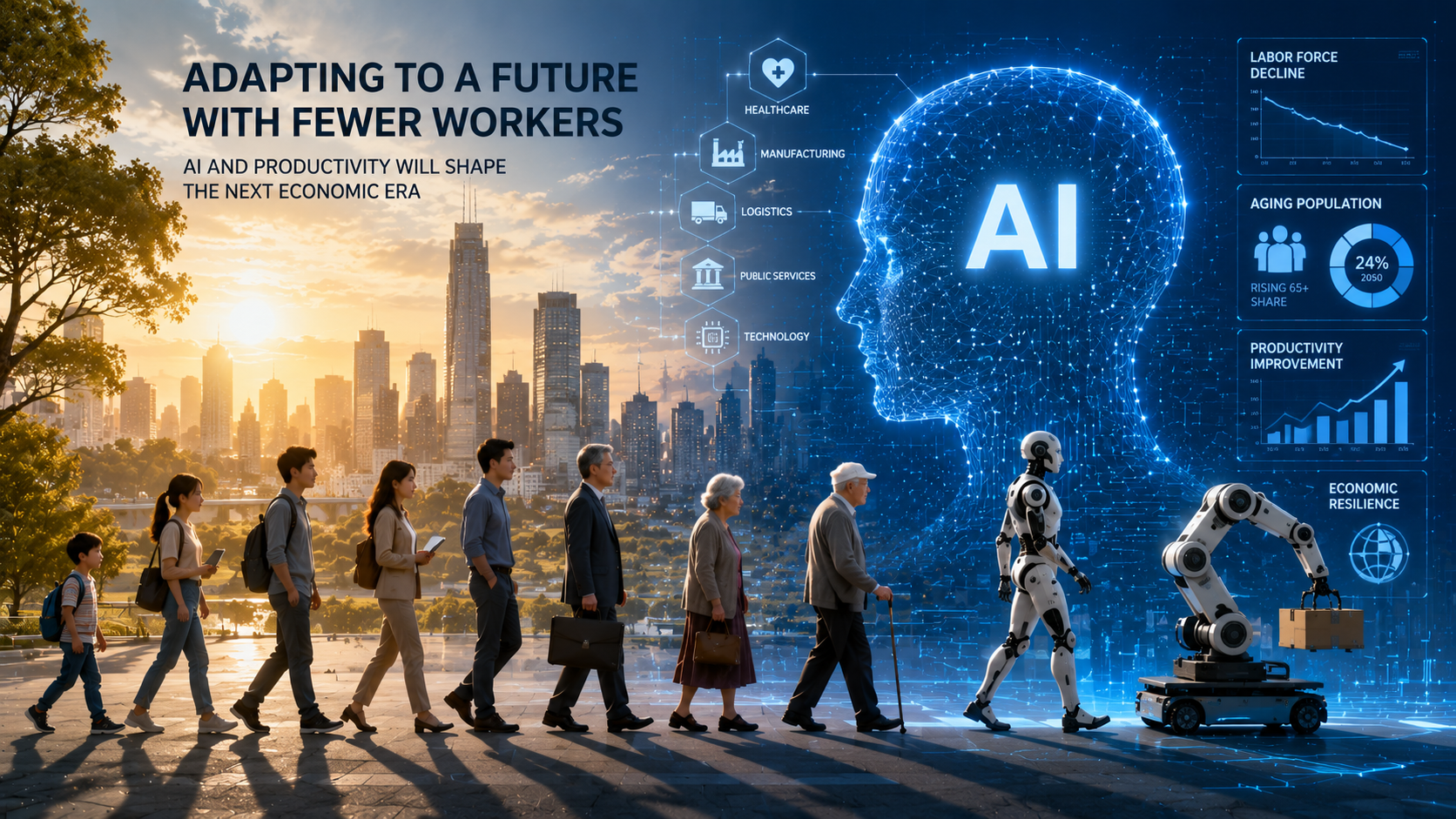
Why Population Decline May Become One of the Biggest Economic Stories of the AI Era
Population growth is slowing across many economies. This analysis explores why artificial intelligence may become an essential tool for maintaining productivity, supporting public services, and adapting to long-term demographic change.
By Val Andrew | chainintellectcoin.com | June 6, 2026
Val Andrew covers artificial intelligence, economic infrastructure, demographics, and digital transformation.
The Economic Challenge Few People Are Talking About
Artificial intelligence dominates headlines.
Markets focus on:
- AI models
- automation
- technology stocks
- productivity gains
- software innovation
Yet beneath these discussions, a much larger long-term trend is quietly reshaping the global economy.
Population growth is slowing.
In some countries, populations are already shrinking.
This raises an important question:
Can artificial intelligence help economies adapt to a future with fewer workers?
The answer may influence economic growth, healthcare systems, labor markets, and public finances for decades to come.
Why Demographics Matter More Than Many Investors Realize
Economic growth has historically depended on three major drivers:
- labor
- capital
- productivity
Population growth supported labor-force expansion throughout much of modern economic history.
Today, however, many developed economies face:
- aging populations
- declining birth rates
- labor shortages
- rising dependency ratios
This creates structural challenges that cannot be solved through traditional economic policies alone.
Demographics move slowly.
But their impact can be enormous.
The Historical Pattern
History shows that labor shortages often accelerate innovation.
During previous periods of economic transformation:
- mechanization increased industrial productivity
- automation improved manufacturing efficiency
- digital technologies transformed information work
Technology frequently becomes most valuable when labor becomes scarce.
Artificial intelligence may represent the latest stage of this pattern.
Rather than simply replacing workers, AI may increasingly help economies maintain productivity despite slower labor-force growth.
Real-World Context
Governments, businesses, and international institutions are paying increasing attention to demographic challenges.
Major companies including:
- Microsoft
- Amazon
- IBM
continue investing heavily in artificial intelligence technologies that improve efficiency, automation, and decision support.
At the same time, countries across Europe and Asia are evaluating policies designed to address aging populations and workforce constraints.
The discussion increasingly extends beyond technology and into long-term economic planning.
A Practical Example
A practical example can already be seen in healthcare.
Many countries face growing healthcare demand while simultaneously experiencing shortages of medical professionals.
AI is increasingly being explored as a tool to:
- streamline administration
- support diagnosis
- improve workflow efficiency
- reduce operational burdens
The goal is not necessarily to replace healthcare workers.
The goal is to help healthcare systems manage rising demand with limited resources.
Similar patterns are emerging across logistics, manufacturing, finance, and public services.
The Contrarian View
Many discussions frame AI as a threat to employment.
The larger economic question may be different.
What happens if future economies struggle to find enough workers?
In such an environment, productivity-enhancing technologies become increasingly valuable.
The most important role of AI may not be replacing labor.
It may be helping societies adapt to labor scarcity.
This represents a very different perspective on technological change.
The Productivity Imperative
As demographic growth slows, productivity becomes increasingly important.
Productivity improvements can help economies:
- maintain living standards
- support public services
- offset workforce shortages
- improve competitiveness
- sustain economic growth
Historically, productivity growth has been one of the strongest drivers of long-term prosperity.
Artificial intelligence may become one of the most significant productivity technologies of the coming decades.
The Global Competition
Countries increasingly view AI capabilities as strategic assets.
Governments are investing in:
- research infrastructure
- workforce development
- digital modernization
- advanced manufacturing
- AI innovation
This creates a new form of economic competition.
Nations that successfully combine demographic adaptation with technological innovation may gain long-term advantages in productivity and economic resilience.
The future may depend not only on population size but also on how effectively economies use technology.
The Risk
Technology alone cannot solve demographic challenges.
Important risks remain:
- unequal access to technology
- workforce displacement
- educational gaps
- implementation costs
- regulatory uncertainty
AI may improve productivity, but successful adaptation also requires investment in education, infrastructure, and workforce development.
Economic transformation rarely occurs automatically.
The Deeper Insight
For much of modern history, economic growth benefited from expanding populations and growing labor forces.
The coming decades may look different.
Many economies will increasingly depend on productivity rather than population growth.
This is where artificial intelligence becomes economically significant.
The most important AI story may not be about machines replacing workers. It may be about helping societies prosper in a future where workers themselves become increasingly scarce.
Where ChainIntellect Coin Fits Into the Broader Shift
Projects such as ChainIntellect Coin reflect the broader movement toward intelligent digital infrastructure, where automation, interoperability, and data coordination increasingly support complex economic systems.
As AI becomes more deeply integrated into healthcare, finance, logistics, and public infrastructure, intelligent digital ecosystems may play a growing role in helping societies adapt to long-term structural change.