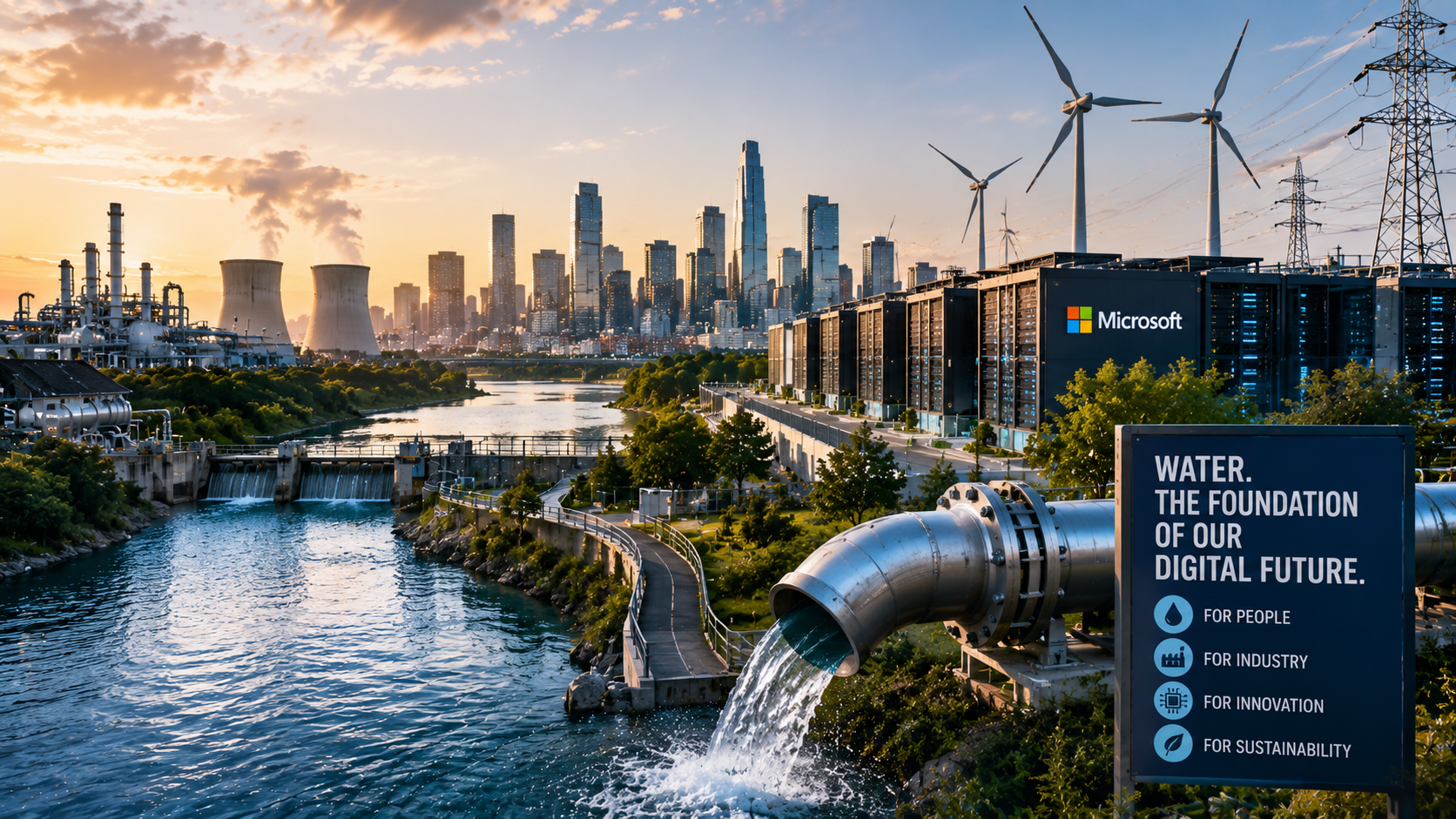
Why Water May Become One of the Most Valuable Resources of the Digital Economy
Water supports manufacturing, energy, data centers, and economic growth. This analysis explores why water infrastructure may become one of the most important strategic assets of the digital economy.
By Val Andrew | chainintellectcoin.com | June 9, 2026
Val Andrew covers infrastructure, technology, economic development, and long-term market trends.
The Resource Most Economies Depend On
When people think about the future economy, they often focus on:
- artificial intelligence
- semiconductors
- energy
- automation
- digital infrastructure
Yet one of the most important resources behind all of these systems receives surprisingly little attention.
Water.
Every major economy depends on reliable access to water.
Cities require it.
Agriculture depends on it.
Manufacturing consumes it.
Data centers increasingly need it.
As populations grow and infrastructure demands expand, water is becoming more than an environmental issue.
It is increasingly becoming an economic issue.
This raises an important question:
Could water become one of the most strategically important resources of the digital economy?
Why Water Matters More Than Many People Realize
Water supports nearly every layer of economic activity.
It plays a critical role in:
- food production
- manufacturing
- energy generation
- transportation systems
- public health
- industrial development
Historically, societies often developed around reliable water access.
Modern economies remain deeply connected to the same reality.
The difference is that today's infrastructure systems are far more complex.
The Historical Pattern
Throughout history, access to water has influenced economic development.
Major cities frequently emerged near:
- rivers
- coastlines
- lakes
- transportation corridors
Water supported trade, agriculture, industry, and population growth.
In many cases, infrastructure investments such as dams, reservoirs, and distribution networks helped drive economic expansion.
The connection between water and economic development is not new.
What is changing is the scale of demand.
Real-World Context
Major industries increasingly depend on sophisticated water infrastructure.
Examples include:
- Microsoft operating large-scale data centers
- Google expanding cloud infrastructure
- Amazon investing in data-center capacity
- Intel supporting advanced semiconductor manufacturing
- TSMC operating highly water-intensive chip fabrication facilities
These industries depend not only on electricity and computing power, but also on reliable access to water resources.
A Practical Example
Semiconductor manufacturing provides a useful illustration.
Advanced chip production requires highly purified water throughout the manufacturing process.
Similarly, many modern data centers use water-based cooling systems to help manage heat generated by computing infrastructure.
As demand for artificial intelligence and cloud computing grows, supporting infrastructure requirements also increase.
The digital economy remains connected to physical resources.
The Contrarian View
Many discussions frame the future economy as increasingly virtual.
The evidence suggests something different.
The more digital economies become, the more dependent they often become on physical infrastructure.
Artificial intelligence requires data centers.
Data centers require electricity.
Electricity generation often requires water.
Semiconductor manufacturing requires water.
Digital systems ultimately depend on physical resources.
Water may be one of the most overlooked links in that chain.
The Infrastructure Challenge
Many regions face growing pressure on water systems.
Challenges include:
- aging infrastructure
- population growth
- drought conditions
- industrial demand
- climate variability
Addressing these issues requires long-term investment.
Unlike software platforms, water infrastructure often takes years or decades to develop.
This makes planning increasingly important.
The Global Competition
Countries increasingly compete for:
- talent
- investment
- industrial capacity
- technology development
Reliable infrastructure influences those outcomes.
Regions capable of providing stable access to:
- water
- energy
- transportation
- communications
may gain long-term competitive advantages.
Economic competitiveness increasingly depends on infrastructure resilience.
The Risk
Water challenges vary significantly between regions.
Potential concerns include:
- supply constraints
- infrastructure costs
- environmental pressures
- resource management
- population growth
The challenge is not simply producing more water.
It is managing resources efficiently while supporting economic development.
The Deeper Insight
The digital economy is often described through software, algorithms, and innovation.
Yet every digital system ultimately relies on physical infrastructure.
Water sits at the foundation of many of those systems.
Just as electricity became essential to industrial economies, water infrastructure may become increasingly important to digital economies.
The future may not belong solely to the regions with the most advanced technology. It may also belong to those with the infrastructure capable of supporting that technology at scale.
Where ChainIntellect Coin Fits Into the Broader Shift
Projects such as ChainIntellect Coin reflect the broader movement toward intelligent infrastructure, where automation, interoperability, data coordination, and digital systems increasingly support complex economic environments.
As infrastructure networks become more interconnected, intelligent digital ecosystems may help improve coordination, transparency, and operational efficiency across future economic systems.